Showing posts with label Assignment 1. Show all posts

Monday, April 17, 2017

Review: Sweethearts of Rhythm: The Story of The Greatest All-Girl Swing Band In The World by Marilyn Nelson


Nelson, Marilyn. (2009). Sweethearts of Rhythm: The Story of The Greatest All-Girl Swing Band In The World . New York: The Penguin Group. 80 pages. ISBN 978-0-8037-3187-5.

Awards/Selection Lists:
- ALSC Notable Books

Author's Website: http://marilyn-nelson.com/

Brief Summary:  The International Sweethearts of Rhythm were a multi-racial, female swing band that performed throughout the South and Midwest of the United States during World War II. Facing Jim Crow laws, and discrimination not just because of their skin color, but also their gender, these women fought for their right to play, to inspire, to cheer up the masses suffering the hardest during the war, in every venue, even against others in the industry. They describe the music as being democratic, that it causes everyone to tap their toes, rich and poor man alike. That's what they focused on, that's how they played, that's how they lived.

Personal Reaction: I like this book because it's different, and different appeals to me. The narrative is written in prose, each poem titled with the name of a song played by the band, which would make it unique in itself. What makes this book truly unique is that each poem is not written in the voice of a member of the band or even an audience member, but of the instruments the band members played! Sometimes it is distracting, and I would imagine this to happen more so for those not familiar with poetry, but once you get used to it, you appreciate the quirkiness and creativity of the format, and really focus in on the depth of feeling being conveyed.

As I will discuss in the content evaluation, I do wish that the artist and author notes had come at the beginning of the book, to give some backstory and context to the prose. I think that more could be gotten out of it, if this was the case. Otherwise, the details of the interracial issues, the origins of the band, their original purpose, and their disbanding is lost, even though the poetry is heartfelt.

Front/Back Matter: Title Page, copyright page, dedication, poetry (main content), chronology, author's note, artist's note, bibliography.

Content Evaluation: While I enjoy the unusual prose style, what this book really needed was a prologue, and introduction, something that indicated who these women were and where they came from. You can glean from the poetry that they lived in the south, fought against Jim Crow laws, were sometimes interracial, though primarily African American, but it isn't until you read the Author and Artist notes that you truly understand what it is you just read. I would recommend to the publisher that these "notes" be included at the beginning of the text to give the readers, particularly younger readers who may not yet have advanced skills analyzing or understanding poetry, the context of the poetry. However, the bibliography and chronology are extremely useful and I believe readers will appreciate the inclusion as well.

Friday, May 9, 2014

Review: Stitches: A Memoir by David Small

Small, David. (2009). Stitches: A Memoir. New York: W.W. Norton & Company. 331 pages. ISBN 9780393068573

Awards/Selection Lists:
- Richie's Picks
- NBA Young People's Award Finalists 2000- 2013

Author's Website: http://davidsmallbooks.com/

Brief Summary:  Born into a dysfunctional, cruel and angry house, the young David Small suffered in sadness and darkness, just wanting to be loved and taken care of, so much so that he looked toward the hospital staff when he had surgery at the age of 14 to remove a growth, as a sort of family. That was, until he saw what they had actually done to him, and later found out why. Fumbling for his own way, his right of passage burned on until he finally found a way to be true to himself and break free of the cycle set before him , to forge his own path.

Personal Reaction: The book jacket described this book as a silent film, and I have to agree with them. The images scream so much louder than any words could, and it's appropriate, given the operation that the author undergoes as a teen and the stifling cruelty and dysfunction of his family. I was sad, the entire time I read this book, and troubled. I felt like that kid. I went where he went, was terrified when he was, desperate with a small glimmering of hope that was none to bright at the end, but the only thing to latch onto. This was a very, very powerful book and there was no better way, in my opinion, to portray it than in this graphic format. It was painful, but, in a way, cathartic, for when you break a cycle, you feel vindicated, and somehow, powerful where you had none of it before.

Front/Back Matter: Title page, copyright page, dedication, secondary title page, content, pictoral background on author, acknowledgments, about the author.

Content Evaluation: This book is, for all intense and purpose large graphic novel, and brilliant in my opinion, at that, so it does not have the typical format of an autobiography, and no references of course. But what it does have is character and heart, you can practically feel the uncomfortableness and sad cruelty in the illustrations before we ever get to the word. It is very powerful.


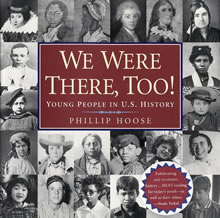
Review: We Were There, Too! : Young People in U.S. History by Phillip Hoose


Hoose, Phillip. (2001). We Were There, Too! : Young People in U.S. History. New York: Melanie Kroupa Books/Farrar Straus Giroux. 264 pages. ISBN 9780374382520

Awards/Selection Lists:
 - NBA Young People's Award Finalists 2000-2013
- Publishers Weekly Best Children’s Books of the Year
- American Library Association Best Books for Young Adults

Author's Website: http://philliphoose.com/


Brief Summary:  Sybil Ludington rode almost 4 times as far and long as Paul Revere for the same purpose. John Adams was a translator as a child. Claudette Colbert refused to give up her bus seat long before Rosa Parks. James Forten worked to abolish slavery not long after the Declaration of Independence was signed. Whether they were planting Indigo, holding back British forces, helping stitch the star spangled banner, organizing for fair labor, leading protests against the Vietnam War, fighting in WWII, revolutionizing the world's technology, starting environmental movements that would later shape the globe...these things were all done by children. They were all there, fighting, living, breathing, dying, putting their lives on the line, innovating, protecting, surviving time and again, overcoming incredible odds, and make a difference, making themselves heard, when no one thought to listen. Phillip Hoose gives them a voice and proves every young person can make a difference. Every person, young or old has a voice.

Personal Reaction: I believe this to be an ideal book for young people who are feeling lost in the world, just like so many of Phillip Hoose's titles. He is so good at giving children a voice, showing their extraordinary efforts and talents, showing that they can make a difference, they can be heard, they can be strong and persevere. They are just as astonishing, if not more so because of their young age, than their adult counterparts and make just as big of an impact. It makes the reader feel...important, to see people just like them overcoming, making a stand, doing what they thought was right, often overcoming not just the prejudice of age, but also color, gender, nationality, and idea. If you look, in every major even in history, they are there, just waiting to be heard, and Hoose did an amazing job of giving brief but thorough overviews of their accomplishments. In fact, he found so many, they filled up NINE parts in this book, and I'm sure there was plenty of room for more.

Front/Back Matter: Title page, copyright page with dedication, table of contents, introduction, acknowledgments, sources (by part...total of 9 parts in book), index.

Content Evaluation:  There was a lot of content to cover, so the way that Hoose has the book organized, chronologically and in sections, makes sense, and the index and table of contents makes navigation easier. He is relatively thorough with his list of sources, though slightly less so than in previous books, where there were more author notes and selected bibliographies. Still, there is plenty of citation of reputable factual material, and illustration or photos where available, though it would have been nice to have seen some color in the book, to catch the eye and keep the reader moving.

I would recommend this book be displayed, either in Young Adult, or in the Teen section, particularly, as a way to empower youth patrons and show them what can be done with direction and drive.

Review: Bootleg: Murder, Moonshine, and the Lawless Years of Prohibition by Karen Blumenthal

Blumenthal, Karen. (2011). Bootleg: Murder, Moonshine, and the Lawless Years of Prohibition . New York: Flashpoint Publishing. 154 pages. ISBN 9781596434493

Awards/Selection Lists:
- YALSA Excellence in Nonfiction Award, 2012 finalist
- American Library Association ALSC Children's Notable List 2002-  

  2013    
- Booklist Editor’s Choice Award, 2011
- Capitol Choices, 2011
- CCBC Choices, 2011
- Junior Library Guild selection
                                           - Kirkus Reviews Best Books for Teens 2011
                                           - School Library Journal Best Books of 2011
                                           - Texas TAYSHAS list

                                           - Richie's Picks


Author's Website: http://www.karenblumenthal.com/

Brief Summary:  With the help of such figures as Carrie Nation and Morris Sheppard, newly found temperance leagues fought a highly visible campaign against the ill effects of liquor on the sanctity of lawfulness and family in the United States. Utterly convinced that liquor was the cause of illegal activity, families falling apart, and all difficulties in the nation, these characters papered Washington, D.C., with pamphlets, introduced health primers in school with the dangers, exaggerated or not, of alcohol, broke up barrooms and saloons, and convinced citizens, particularly women, that it was their duty to put an end to drunkenness, and liquor consumption.When they had made enough noise to gain the imagination of the nation, John Volstead pushed hard to pass the 18th amendment, prohibiting the consumption or selling of liquor with an alcohol content of over .5 of 1%, unless kept in the home or for medicinal purposes. He was determined that this amendment would prevent drop outs and illegal activity, only to give rise to severe illness and the most notable and violent criminals ever known, like Al Capone, when people began to make and distribute their own alcohol, often paying officials bribes to continue their business unharmed. This phenomenon was known as bootlegging and it would take 2 more presidents before the amendment was repealed, and the dangerous process was all but halted, in an attempted to save America from the lawlessness that had been inspired by what people considered an idea of civility.

Personal Reaction: I thought this book had a lot of good information on the history of prohibition from start to finish, but it was a little lackluster and dry (no pun intended) in some areas, making it difficult to stay focused and interested. This could also be because of my propensity to become annoyed with characters, factual or not, that believe they know what is best for all people, and attempt to take away their freedoms over their own fears. I would love to say that the originators of the temperance movement had nothing but good intentions, but it is very clear from this book that simply wasn't the case, and in more than one instance, was an opportunity for power play, control, and the exhibition of more than one example of mental illness, and the inability to deal with personal tragedy.

Front/Back Matter: Photograph, title page, copyright page, table of contents, content, glossary, bibliography and source notes, source notes by chapter, acknowledgments, picture credits, index.

Content Evaluation: As previously stated, the tone was a bit lackluster, but there was a lot of good information included and the front and back matter is exceptionally thorough. I'd like to see more of the emotional impact and first hand accounts of people who lived through and were affected by the period and the amendment. I think that would go far to make the content a little more relatable, though it is easy to draw correlations between the fight against alcohol and current legislative issues with guns, tobacco and marijuana use.

Review: American Shaolin: Flying Kicks, Buddhist Monks, and the Legend of Iron Crotch: An Odyssey In the New China by Matthew Polly

Matthew, Polly. (2007). American Shaolin: Flying Kicks, Buddhist Monks, and the Legend of Iron Crotch: An Odyssey In the New China. New York: Gotham Books. 224 pages. ISBN 9781592402625

Awards/Selection Lists:
- A Compilation of Nonfiction titles on Best Books for Young Adults Top  Ten lists, 2001-2010
- Alex Award-Winning Nonfiction Titles, 1998-2013

Author's Website: http://mattpolly.com/

Brief Summary:  This is the story of author Matt Polly, and his rise from a skinny American kid, lost in the ways of the world, with only one desire, to go to China and learn KungFu from the Shaolin Monks themselves, to the defender of Shaolin tradition, tournament style. He learns discipline, he learns pain, he learns how to navigate the turbulent waters of China a mere stones throw in time from the period of Tiananmen Square, and the prejudice that Americans are expected to endure as foreigners in a contradictory land of corruption, honor, tradition and change. Because of his dedication and skill, Matt Polly became the first American ever inducted into the Shaolin Temple but it was not without sacrifice and an emotional inner journey.

Personal Reaction: Matt Polly writes of his 2 year journey in China with style and wit. He is undoubtedly funny and has maintained a sense of humor, even when recounting the most humiliating and difficult times of his journey in a country where walking on eggshells was necessary for daily living, as loyalties shifted as easily as a rolling tide. At times some of the technical jargon of KungFu can become distracting, but I found myself still enjoying the story, as if a favorite friend was telling me a story of their great adventure. Even though it wasn't one of my favorite books, it is one of my favorite stories and his reactions then, and the flavor of his address is charismatic and familiar. I would definitely recommend this book to reluctant readers who may be feeling a little lost in the world, but who also have some interest in martial arts. The chapter on Iron Crotch Kungfu alone had me in stitches. His reactions and recollections were priceless, and very easy to relate to. I love this man's writing style.

Front/Back Matter: Title page, dedication, table of contents, a note on spelling and pronunciation, secondary title page, Chinese proverbs, prologue, author's note, acknowledgments.
Content Evaluation: I would have liked to have seen a little more about Chinese culture, as references or appendixes in this book, but a beginning primer for the more important Chinese names, and Polly's explanation of his education in Chinese culture is enough to get you through. The tone is funny and relatable, at times serious, but still maintaining and element of play. It is laid out logically and does not include an index or source notes, typically because this is a first hand telling, an autobiography, rather than a research project.

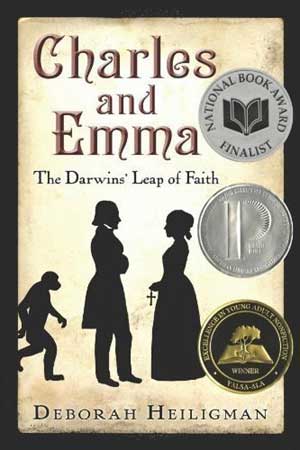
Review: Charles and Emma: The Darwins' Leap of Faith by Deborah Heiligman

Heiligman, Deborah. (2009). Charles and Emma: The Darwins' Leap of Faith. New York: Henry Holt and Company. 268 pages. ISBN 9780805087215

Awards/Selection Lists:
- Printz Honor 2010
- National Book Award finalist 2010
- L.A. Times Book Prize Young Adult Literature Finalist
- YALSA Excellence in Nonfiction 2010
- CCBC Choices List 2010
- Oprah's Book Club 2010 Kids' Reading List: 12 and Up
- New York Times Editor's Choice

Brief Summary:  Through and through, this is the love story of Charles and Emma Darwin, literally kissing cousins who married and had a typical Victorian family, typical except that Charles was shaking up the world by redefining the world's view of creation, nature and the origin of man. Being mildly spiritual, where his wife was incredibly devout, after losing her sister, it became a gulf between then, that they had to span by a leap of faith. Together they endured tragedy, controversy, devastation, ill health, strife, and Emma's growing concern that she wouldn't meet her beloved husband in the after-life, yet they still came out together, still in love and still devoted, with a good tale to tell.

Personal Reaction: I had a difficult time finishing this book. In fact I had to pick it up and put it down twice. While the story of Charles and Emma Darwin is really interesting, I was constantly distracted by the constant interference of Christianity in their story. I understand the context of this element. In England, during the time period, it was extremely common for Victorian women to be incredibly devout, and for religion to rule the roost, and also I understand the strife and heartache it caused Emma. However, at some point during the story, it, and the difference between their two faiths, started to sound more like a nagging presence rather than an obstacle to be overcome and I found myself annoyed. I wanted to learn more about their dynamic, the trials and tribulations they went through, his work, his family, and while I understand that religion and the moral views of the time period were intertwined, I wish they hadn't upstaged his incredible journey.
 
Front/Back Matter: Title Page, copyright page with dedication, table of contents, foreword, content, acknowledgements, family trees, source notes, selected bibliography, index.
 
Content Evaluation: The tone could be a little dry, though certainly you can tell that the author was interested in her subject. While a selected bibliography is less superior than a full one, the source notes, which take up more than 14 pages, are excellent, and arranged by page number and occurrence. I would have liked to have seen more illustrations and photos of the Darwins and Charles' work. I think it would have helped carry the story and immersed the reader in the world.


Wednesday, May 7, 2014

Review: Amelia Lost: The Life and Disappearance of Amelia Earhart by Candace Fleming

Fleming, Candace. (2008). Amelia Lost: The Life and Disappearance of Amelia Earhart. New York: Schwartz & Wade. 128 pages. ISBN 9780375841989

Awards/Selection Lists:
- Nonfiction titles from ALSC Notable Books lists 2002-2013
- Bulletin of the Center for Children's Books, starred review
- Golden Kite Award for Nonfiction, 2012
- Horn Book, starred review
- Kirkus Reviews, starred review
- School Library Journal, starred review

- Richie's Picks


Author's Website: http://www.candacefleming.com

Brief Summary:  Most people know of the amazing story of Amelia Earhart, the first woman to cross the Atlantic, lost of her world hopping trip across the equator, with her troubled but brilliant navigator, Fred Noonan. There have been numerous books over the years speculating over the why and the how but this is the first book I have read that actually chronicles the life, from beginning to end, and nature of Amelia Earhart. A tomboy, a student, a nurse, a social worker, a sister, a daughter, a firecracker, a pilot, a wife.....she was many things and she led a colorful life and broke through social barriers with a finesse that continues to inspire generations of women. She wanted to be free, she wanted to be happy, and no one was going to get in her way.

Personal Reaction: I really, really enjoyed this book. Earhart has been a favorite subject for me since I was child. I grasped onto characters who refused to be pushed around and hide who they were, who bucked against the system to pave the way for future children to find their true paths, hopefully with less discrimination and hardship. This book on Amelia's life is the most complete, compassionate, personal I have read. There are so many photos and accounts, personal details that many others leave behind that really let you connect with her character, her choices and her driving force. I particularly like the interspersed "special sections" which recount first hand accounts of people, many being children, who believe they heard some of Amelia's final words or discovered her location, though no one would listen.

Though her death was incredibly sad, she left a legacy, and through the story that Candace Fleming weaves of her life, we can really understand what a brave and formidable woman she was.
 
Front/Back Matter: Title page, copyright page, acknowledgments, contents, foreword (Navigating History), content, bibliography, "Finding Amelia on the web" sources notes by chapter, picture credits, index.
 
Content Evaluation: This book is very well organized, with a lot of source notes (which I love, it always makes the book easier to believe in), and fantastic resources. There are hundreds of photographs included, but they are organized in a way that doesn't detract from the story, but rather helps carry it and form attachment. The tone is strong, factual, but compassionate and it is a great, and fast read.


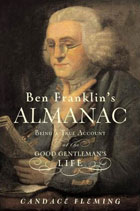
Review: Ben Franklin's Alamanc: Being a True Account of the Good Gentleman's Life by Candace Fleming

Fleming, Candace. (2003).Ben Franklin's Alamanc: Being a True Account of the Good Gentleman's Life. New York: Atheneum Books for Young Readers. 119 pages. ISBN 0689835493

Awards/Selection Lists:
- Richie's Picks
- ALA Children's Notable Book
- ALA Best Book for Young Adults
- Association of Booksellers for Children Fall Favorite 2003
- Book Links Best Book 2003
- Booklist Top ten Biography for Youth, 2003
- CCBC Choices 2004
- Children's Literature Choice 2004
- Great Lakes' Great Books Nominee 2005
- James Madison Award Honor Book
- Jefferson Cup Honor Book (Virginia Library Association) 2004
- Junior Library Guild Selection
- Maine Student Book Award Nominee 2004-2005
- NCSS-CBC Notable Social StudiesTrade Book 2004
- New York Public Library Best Book for Reading and Sharing, 2003
- New York Public Library Best Book for the Teen Age, 2004
- Parents Choice Gold Award Winner
- Publishers Weekly Best Book of 2003
- Riverbank Review Children's Book of Distinction 2004
- School Library Journal Best Book of 2003
- Washington D.C. Capitol Choices Book 2003


Author's Website: http://www.candacefleming.com/

Brief Summary:One of the founding fathers of the nation, Benjamin Franklin is well known, and his accomplishments well documented. Laid out in chronological order, Fleming leaves no stone unturned to reveal Franklin's tenacity, ingenuity, curiosity and his utmost desire to do right by his country, his children, and those he served, by improving, doing, pushing the envelope and not being afraid to offend those in power by being honest, just and proud.

Along with his innovations in his electrical experiments, instituting state schools, libraries, fire brigades, becoming first Postmaster General, being a member of the Continental Congress, helping write the Declaration of Independence, he was a skilled diplomat, a lover, a writer, a man who believed less in organized religion and more in the spirituality of doing the right thing and being chased by the consequences throughout subsequent life-times. He was a complex and interesting character whose humanitarian efforts are often outweighed by the extravagances of his later diplomatic years in France, in part due to the outrage of John Adams wife. Nevertheless, he remains, one of America's most spectacular historical figures, with much more to tell.
 
Personal Reaction: I won't lie, I had a hard time getting through this book. I am very interested in the content, and there is SO much information that I had not previously read on Franklin. You really get a sense of his desire to help his fellow man, of his humility, and his curiosity through Fleming, but it is a bit overwhelming being crammed in small print into 119 pages. Also, while there are many illustrations, everything is in black and white and made to look like an old fashioned newspaper page, which I understand the desire for. However, it makes it difficult to stay focused on the content as there is no color to relieve the eye and offer excitement and a way to really connect with Ben's character.
Front/Back Matter:Title page, copyright page, table of contents, foreword, chronology, content, bibliography, picture sources, additional resources (one page for books, another for websites), index.

Content Evaluation: Very well informed and well documented, the content is extremely fact heavy. I would have liked to have seen a more personal narration, some way to connect and empathize with Ben, rather than just being told about his life. The use of color and a different format might lead to a better review of this book. I think I will attempt to re-read it for leisure, to re-assess if my perceived time constraint caused me to be less entertained by this book. However, its relative dryness is one of the things I dread most. Hundreds of tiny stories inserted into different frames on the page also make it difficult to keep the chronology straight. Still, as I said, I'm willing to give it a second chance.


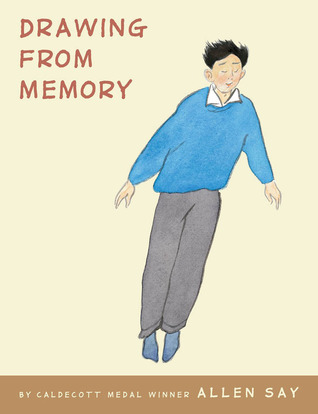
Review: Drawing From Memory by Allen Say

Say, Allen. (2011). Drawing From Memory. New York: Scholastic Press. 72 pages. ISBN 9780545176866

Awards/Selection Lists:
- Nonfiction titles from ALSC Notable Books lists 2002-2013
- Richie's Picks
- Siebert Honor


Author's Website:http://www.houghtonmifflinbooks.com/authors/allensay/

Brief Summary: Allen Say is an award winning, Japanese born illustrator and writer who led a very interesting and independent life, determined to become a cartoonist, seeking out his mentor, his sensei, on his own at the tender age of 13, while living on his own and attending school. Later, he moves to America with his estranged father, to live his dream, but the relationship with his sensei, and what he has learned about drawing as seeing and painting as writing, stays with him forever, as this memoir to his great teacher proves.

Personal Reaction: I adored this book. I love Japanese culture and this book reads an awful lot like a lot of the literature I have read from that area. It may seem a little choppy, and some of the content is told with pictures instead of language, which could be why this is listed in our OPAC as a graphic novel, regardless of the fact that it is covered in photos and cartoons, but I think that it fits very well with the storyline and the geography. Say led a very interesting life, and it is amazing to see the amount of independence post war Japan allowed him, and never thought twice about. Even with his father, his grandmother, and some teachers telling him he would never amount to anything as an artist, he pursued his passion, encouraged by his sensei, 2 teachers and a few friends to become one of the most celebrated talents.

Personally, I think what I love most about this book is that I always wanted to be an artist, but was always told that it wasn't lucrative enough to be an occupation, and then the time I could have used to train and perfect a craft was wasted, as it became a sometime hobby, and one that I often hid from others. I really take Say's story to heart because he pursued his passion to the very end and lived his dream. Like those people he saw in Tokyo that lived and died in offices, I lived that way, and I would prefer to live like Say, following his example. It makes you wonder, is it ever really too late?
Front/Back Matter: Title Page, main page, copyright page, dedication, content, author's note.

Content Evaluation: As stated above, the tone is a little choppy, but very appropriate for a Japanese styled book and I think it carries the story, very well. The photos and illustrations are plentiful, the language easy to absorb and the author's note helps tie it all together, really identifying the purpose of this book, to honor his sensei.


Review: Raggin' Jazzin' Rockin': A History of American Musical Instrument Makers by Susan VanHecke

VanHecke, Susan. (2011). Raggin' Jazzin' Rockin' : A History of American Musical Instrument Makers. Honesdale, Pennsylvania: Boyds Mills Press, Inc. 136 pages. ISBN9781590785744

Awards/Selection Lists:
- Nonfiction titles from ALSC Notable Books lists 2002-2013


Author's Website: http://www.susanvanhecke.com/

Brief Summary: Did you know that Avedis Zildjian was originally a candymaker, his namesake the original maker of the cymbal 300 years previous, in Turkey? Leo Fender was a radio repairman,  and Laurens Hammond, whose name is found on grandma's classic organ in the living room, invented 3-D glasses! Men like this weren't necessarily music makers themselves, but they forever changed the face of American music by their innovation and imagination just as much, and in some cases more, as the musicians chronicled in this book, who took a chance and improved the profession that they loved, while starting businesses that would become household names.

Personal Reaction: I love to heard the history behind instrument makers, and the effects that they had on music of the day. There is a lot of music history in this book, packed between the stories of instrument makers, that makes this book dual purpose. The tone is charming and personable, with a lot of excellent pictures and illustrations. I particularly like the story of Heinrich Steinway (formerly Steinwegs) making pianos in his kitchen, and how he literally changed the shape of the piano, as we know it today, his family even building their own concert hall so that musicians could exhibit their talent, and the instrument simultaneously.

Did you know that during World War II they actually stopped making pianos and started making airplanes, and even the great brass horn maker Conn was making military navigation instruments?! Martin, Fender, Ludwig, Moog...these men are legends in the industry, developing innovations, techniques and instruments of distinction for decades and even centuries, and all are covered in this book as well. No matter where you look, these folks survived tragedy, death and the odds to bring music and their dreams to the American people, and people across the world really. It's also interesting to note that MANY of these incredible artists, had families that immigrated from Germany.

The book is also made all the better because each purchase goes toward continuing music education in schools.

Front/Back Matter:Title Page, copyright page, table of contents, introduction, content, "A Closing Note", Notes (including sources), index.

Content Evaluation: The content in this book is amazing. Stashed in the margins and between photos and histories of these famous instrument makers are the types of music and big names in the industry who influenced, or were influenced, by the instruments and makers themselves, showing how the world and industry changed over time, and how one development influenced the other in a symbiotic relationship.

There are a phenomenal amount of resources included, in additional to the basic bibliography, and quote sources are listed by chapter, so it is easier to believe in the authenticity and accuracy of the information presented. The historic photographs and illustrations really carry along the story and make it more exciting that the title could possible suggest. It can get a little long for those not terribly interested in the subject, and even I had a hard time staying interested by the time I reached my favorites (Martin and Fender), but I highly encourage the reader to wade through each chapter. You'll find some amazing stories of perseverance, tradition and innovation.

Tuesday, May 6, 2014

Review: Our Eleanor: A Scrapbook Look at Eleanor Roosevelt's Remarkable Life by Candace Fleming

Fleming, Candace. (2005). Our Eleanor:A Scrapbook Look at Eleanor Roosevelt's Remarkable Life. New York:Atheneum Books. 192 pages. ISBN 9780689865442

Awards/Selection Lists: 
- Nonfiction titles from ALSC Notable Books lists 2002-2013
- Richie's Picks 
- ALA Notable Book
- Best Book for Young Adults
- Jefferson Cup winner,Virginia Library Association
- Junior Library Guild Selection
- New York Public Library 100 Titles for Reading and Sharing 2005
- Oppenheim Toy Portfolio Gold Medal Winner
- Parent's Choice Gold Medal
- Publishers Weekly Best Book 2005
- School Library Journal Best Book 2005


Author's Website: http://www.candacefleming.com

Brief Summary:  Most people know of Eleanor Roosevelt's generous and charitable acts, her contributions toward making the United States a better place during her husband, Franklin D. Roosevelt's presidency. What they may not know is that she came from an unhappy childhood, where the seeds of insecurity were planted that would haunt her the rest of her life. From a cruel mother to a drunken father, a harsh grandmother, wild and crazy aunts and uncles, Eleanor would eventually find her place in the world, and find where her true power and happiness came from, making other people's worlds better; making a difference in the lives of those who truly needed it, and it was her inspiration and intelligence that led to many of the reformations that swept the country during FDR's presidency, though after his death, she felt she could finally be her true self, and as she said "The story is over." But was it?

Personal Reaction: I've always thought of Eleanor Roosevelt as a great lady. I had heard rumor of FDR having an affair, but Eleanor's relationship with FDR always seemed so strong in everything I had read, and I do believe that he would not have been as successful a president if she had not had the strength to stay with him, though the love and trust had gone from their marriage. They truly became partners and that is a fortitude I am not sure I could have mustered. She was a lonely child and crazed attention, and I feel I can relate to her in so many ways. She wanted to be loved, she wanted to be liked, and part of that lead her to that feeling of fulfillment she finally found in helping the less fortunate who simply wanted a better life for their children. I think, in a way, Mrs. Roosevelt was working toward making sure that every child she touched had a better, more secure life, even if it was simply emotionally, than she had. We all want to provide a better world for our children, and it seems as if Mrs. Roosevelt was finally coming out of her shell and playing mother to the world. She is one of those characters from history that I wish I could have befriended. I think we would have had a lot in common.
 
Front/Back Matter: Title page, copyright page, acknowledgments, table of contents, foreword (a personal note), chronology, family tree, resources (More about Eleanor), picture credits, source notes.

Content Evaluation: The layout is very logical and the tone intriguing. There is a lot of information to sort through, but I found the information interesting, particularly the passages on her later life, where I saw the issues from her past being resolved in the present, through others. The sources and resources are plentiful for further exploration, and the chronology and family tree make it easy to keep things in order, and the relationship between Teddy Roosevelt, Eleanor Roosevelt and Franklin Roosevelt apparent. Overall, a great history of an amazing lady.

Review: Genius: A Photobiography of Albert Einstein by Marfe Ferguson Deland

Delano, Marfe Ferguson. (2005). Genius: A Photobiography of Albert Einstein. Washington D.C.: National Geographic Society. 64 pages. ISBN 0792295455

Awards/Selection Lists:  
- ALA/Book Links Best New Books for Classroom
- Outstanding Science Trade Book for Young People
- Notable Children’s Book of Jewish Content-Association Of Jewish Librarie
- Orbis Pictus Honor Book
- New York Public Library Books for the Teen Age
- Nonfiction titles from ALSC Notable Books lists 2002-2013

Author's Website: http://marfebooks.com/

Brief Summary: As one of histories most recognizable figures, Marfe Ferguson Delano profiles the life of scientist and humanitarian, Albert Einstein, from his beginnings in German, Italy and Switzerland, to America, his 2 marriages, 2 sons, and 2 step-daughters and puts to rest the unfounded rumors that Einstein took bad marks in school due to lack of proficiency, his involvement in the Manhattan Project and that his life as a patent clerk was all drudgery. As one of the world's most brilliant thinkers, and the father of quantum physics, Einstein maintained his childish enthusiasm, his curiosity about the world and his desire to make it a better place, inspiring generations to come, even landing on the cover of a very famous magazine at the turn of the 21st century.

Personal Reaction: Albert Einstein is one of my favorite characters from history, notably because he was what people considered to be relatively eccentric. He was brilliant, tempestuous and precocious as a child, but loving, with parents who encouraged his independence and imagination. As an adult he was a pacifist, a thinker, full of imagination and curiosity, following love and wanting to make the world a gentler place. As he grew older his appearance became more disheveled,  he never wore socks, and he was never more loved or respected as a hero, even by people who had no idea what his theories and articles meant. Above all, I think I respect not only his intelligence but his gentle nature, a lover not a fighter. You don't hear of many people who made an indelible mark on the world who follow that philosophy.

While the book was brief, it gave a good overview of his life, from birth to death, though the chapter on his death seemed the most brief. It is interesting to me to note that the condition he died from, an abdominal, aortic aneurism is the same genetic condition that my uncle died from less than a year ago. I think he would have been pleased to know that he had something in common with such a similarly eccentric spirit. While I would liked to have seen more in-depth information, I think this is a great start for those still testing the world of non-fiction and biographies, where excessive length can cause disinterest. I never lost interest, and it left me wanting more, which is often the hallmark of a great writer.

Front/Back Matter: Brief title page, full title page, copyright page with dedication, quote, foreword, content, afterword, chronology, resources, credits, index.

Content Evaluation: The credits are listed chronologically but in an odd configuration that can make it difficult to determine what goes where. However, when quotes are used in the text, it is often followed by a footnote or reference to the original source as well, which helps. The additional resource page is helpful, as is the information on the Albert Einstein Archives. I would have liked to have seen more content, as mentioned above, but the overview of Einstein's life is more appropriate for Young Adults still venturing into the genre to test the waters. It's not too overwhelming and of good overall length, so that I would not hesitate to recommend this for older tweens as well.

Review: Claudette Colvin: Twice Toward Justice by Phillip Hoose

Hoose, Phillip. (2010). Claudette Colvin: Twice Toward Justice. New York: Square Fish Publishing. 160 pages. ISBN 0312661053

Awards/Selection Lists:
- Newbery Honor Book
- Robert F. Sibert Award Honor
- YALSA Award for Excellence in Nonfiction Finalist
- Jane Addams Children’s Book Award, Honor
- ALA Best Book for Young Adults


Author's Website: http://philliphoose.com/

Brief Summary:  Nine months before Rosa Parks made her immortalized stand against segregation on a Montgomery, Alabama bus, a teenage girl in the same city was arrested and jailed for refusing to give up her seat to a white person on a bus. Almost lost to history because she was not considered an appropriate role model for a civil rights movement, it was the court case that she helped bring to the courts of Alabama that ended segregation, though she would tell you, the fight's not over yet.

Personal Reaction: This account of Claudette Colvin's story, in her own words and Phillip Hoose's is fantastic. I could not believe that a story like this had not been presented in school as part of our study of the civil rights movement. This girl had guts, even as a teenager, and dared to take a stand to say "This is not right." Hoose found her story when he was writing "We Were There, Too." and I am so glad he did. We get to hear from Claudette herself the ups and downs, the emotions and thoughts running through her head from the start through the end, why she believes Rosa Parks was a better role model, but also where injustice reined, even in the civil rights movement she helped found with her own sacrifice. It is personal, emotional, brave, outstanding and you can really tell how passionate Hoose was when telling her story. Imagine if we had lost her story  forever. Now her story can help children of all ages learn to stand up for what's right, to be brave, and above all, to make your voice heard.
Front/Back Matter: Title page, copyright page, table of contents, content, author's note, bibliography, notes, acknowledgments, picture credits, index

Content Evaluation: Hoose's tone was enthusiastic, though the format was sometimes a little choppy. His notes, bibliography and picture credits were extensive, though he notes that some citations may be missing. As with most of his books, his resources are excellent, thorough and plentiful, allowing for substantial further research, and offering legitimacy to any information presented as facts.

Review: Children of the Great Depression by Russell Freedman


Freedman, Russell. (2005). Children of the Great Depression . New York: Clarion Books. 118 pages. ISBN  0618446303

Awards/Selection Lists:
- Nonfiction titles from ALSC Notable Books lists 2002-2013
- Golden Kite Award


Author's Website: (Publisher entry. No official site found) http://www.hmhco.com/bookstore/
authors/Russell-Freedman/2231331

Brief Summary:  The Great Depression threaten to permanently cripple the United States during the 1930's. After the stock market crashed in 1929, people began to lose everything. Where once there had been frugality and thrift, there was now desperation. Where there was once segregation and prejudice against people of color, there was downright hatred and abuse, as people were literally fighting for scraps in the street to feed their families. Four million people, including children, migrated across the country looking for agricultural work. Four million people experienced the terrible droughts that left the destitute, desperate and in peril. Shanty towns were built as people were kicked out of their homes. Malnutrition became common. Schools closed, jobs were scarce and a living wage, even more so. While Franklin Roosevelt's New Deal helped bring the country out of the Great Depression, attempting to provide work, pride, and the ability to support one's self and family, the effect on America's children did not go unnoticed. Freedman uses the many photographs taken by government hired documentarians to reach readers, and show them just how bad things really were, how this was not a dream, but a very real, very dangerous period of out country's history through the words of its youngest victims.

Personal Reaction: This is a fantastic book. It's written well, but the content, with all of the poignant photographs makes it much more gritty and real, and quite frankly, heartwrenching. It was a desperate time and I can remember asking my Grandmother about it, and realizing that because of the Great Depression, she had developed habits that never went away, and in fact came in handy during World War II, like storing rubber bands and aluminum foil, and contributing to pack rat syndrome. That whole generation helped teach me how to make it through tough times, how to stretch my pennies and make a meal out of practically nothing. I have an immense about of respect and empathy for those who had to go through this terrible time, and especially for those, like my grandparents, who were so young and seemingly helpless at the time, but still, to this day, do not complain about it. They simply take pride in their accomplishments.
 
Front/Back Matter: Photo, title page, copyright page, dedication page, table of contents, introduction (picturing the Great Depression), content, chapter notes, selected bibliography, picture sources, index.
 
Content Evaluation: This book is beautifully written, with so many exceptionally well cited resources and notes. The photographs are amazing, and even though everything is in black and white, it carries a heart with it, the feeling of depression and desperation, of dryness and struggle, that accompanied the Great Depression, and it works to convey the message of the story, while highlighting the magnificence of the perseverance of those who fought against the terrible times.

Saturday, April 26, 2014

Review: The Trouble Begins at 8: A Life of Mark Twain in the Wild, Wild West by Sid Fleischman

Fleishman, Sid. (2008). The Trouble Begins at 8: A Life of Mark Twain in the Wild, Wild West. New York: GreenWillow Books/Harper Collins. 224 pages. ISBN 9780061344329
Awards/Selection Lists: 
- Nonfiction titles from ALSC Notable Books lists 2002-2013

- Richie's Picks- Richie's Picks Nonfiction titles
Author's Website: http://sidfleischman.com/

Brief Summary:  Most people remember Mark Twain, or Samuel L. Clemens, as an east coast and Missouri man, clever and cantankerous, but funny and brilliant. Many people know that he was a river boat captain in his younger days. Some may even know that he worked in many newspaper offices. But what few people seem to know is that Mark Twain had his own Wild West adventure, starting with the journey to Nevada where his older brother became the only Secretary of the territory. What did Clemens think of the Wild West? How did he get on? What is his connection to gold rush fever, California, and the Hawaiian islands? How did these adventures contribute to his becoming a published author? How did they shape the famous man we know of today?

Personal Reaction: As I'm finding with many of the books I am reading for this non-fiction blogging assignment, I really enjoyed this book. Now, I chose this book specifically because Mark Twain is one of my favorite literary and historical figures. He had a notoriously wicked sense of humor, sarcasm and satire, he loved to stir things up and challenged standard notions of righteousness and propriety. He just had to think for himself and be different and that, I admire. He was distinctive and devoted, talented and troubled. He wasn't perfect but he was colorful and brilliant, and his story inspires me and reminds me that it's ok to be different. In fact, it's probably the best thing I can think of.

At first I thought I was keeping in time well enough with the chronology of events, only to read at the end that many of these accounts may have been inaccurate because of Twain's love of embellishment for the sake of a good story. Then I'd shake my proverbial fist at the memory of Mark Twain, while smiling a wry smile,  and I would try to make sense of what happened. Perhaps this is why the author offers so much back matter, to help with the quest. Or perhaps that was Twain's idea all along. "Can't make it easy for 'em, " I can imagine him saying with a wink.
Front/Back Matter: Title page, copyright page, dedication, table of contents, Preface, content, timeline, references (by chapter and page), illustration and photograph sources, bibliography, "The novels and other works", index.
Content Evaluation: By far the most organized and complete set of back matter in any non-fiction book I have read to date, Fleischman was spot on the mark. He makes it easy for anyone to not only check facts, but keep events in order, reference particular time periods, events and topics and provides sources for further review and study. It really speaks to the dedication of the writer to portray events as accurately as possible and to give a complete picture of such a famous man's life.

I like Fleishman's tone because it is humorous and personal, though once you read at the end of the book that the way the events are depicted might not be accurate kind of turns you on your ear, as far as believing in his pure credibility goes. But perhaps he's wanting us to evaluate for ourselves what is factual and what is not. Still, the book is entertaining, informative and I believe accurately portrays the character of Sam Clemens.

Wednesday, April 23, 2014

Review: We Are the Ship: The Story of Negro League Baseball by Kadir Nelson

Nelson, Kadir. (2004). We Are The Ship: The Story of Negro League Baseball. New York: Jump at the Sun/Hyperion Press.  96 pages. ISBN 0439357918.

Awards/Selection Lists: 
- Coretta Scott King Author Award
- Richie's Picks Nonfiction titles
- Robert F. Sibert Medal

Author's Website: http://www.kadirnelson.com/

Brief Summary:  Up until the 1890's it was very common to see African American's playing professional baseball. Then, seemingly overnight, the league forced out the black players, who had no other choice but to play for Latin America teams or start their own league. In 1920, Rube Foster, a former baseball player, did just that. He joined most of the teams together to form the first professional negro baseball league. They played hard, in most cases at least ten times harder than the white leagues. Little to no equipment, few rules, showy players, bad tempers, opportunistic venues, little compensation, discrimination 3-4 games a day, and not even knowing how they might get from game to game, or where their next meal might be found, even if they had money in their pockets, showed just how dedicated these men were to the game. Along with an opportune comment by a new baseball commissioner in 1944, these men went from entertaining haphazard, though often plentiful, crowds, to re-integrating professional baseball in 1945, when Jackie Robinson was signed to the Dodgers. Unfortunately, while this was a huge step forward, it was also the beginning of the end for a hard playing league that gave many the opportunity and respectability they craved, as hardened and dedicated baseball players.

Personal Reaction: The first thing that comes to mind when I read this book is "beautiful." The story is long, and there are a lot of names you may not remember, and some baseball terminology that the non-sports fan might find daunting, but overall the voice of this book is soft, and kind, hardworking, but above all, honest and humble. It accurately depicts the hardships that these players encountered just to keep on playing, to keep entertaining, to do what they loved and support their families. These men played when everyone else told them they couldn't. They were, in many cases, expected to be more respectable off the field than the other professionals. They were making history. Unfortunately, because of racial tensions and discrimination, many of the sports best players were never recognized. However, with Nelson's book, that grievous wrong is being addressed and many of these players are beginning to see the light of day once more.

Written from the narrative perspective of one of the old time baseball players, Nelson does a phenomenal job of really portraying how hard these men had it, but how many of them never dared to complain, as long as they could play. It's important history, for civil rights, for sports, but mostly, for human kind. The tenacity these folks showed paved the way for all those who followed, fighting for their rights in an unfair world.

Front/Back Matter: Title page, copyright page, dedication, foreword, author's note, acknowledgments, bibliography, filmography, endnotes (by chapter), index.

Content Evaluation: By far this book has some of the most comprehensive back matter I have ever found for young adult non-fiction. References are listed by the chapter they are used in, to help corroborate the research. A lot of background information is provided, along with clearly indexed common terms, and additional resources. The rich tone and the glorious presentation of Nelson's spectacular paintings carry this book all the way across home plate. You don't have to be a lover of baseball to love this book, just a lover a great book and a great story.

Review: The Journey That Saved Curious George:The True Wartime Escape of Margret and H.A. Rey by Louise W. Borden

Borden, Louise. (2005). The Journey That Saved Curious George: The True Wartime Escape of Margret and H.A. Rey. New York: Houghton Mifflin. 80 pages. ISBN 0616339248  .

Awards/Selection Lists: 
- ALA Notable Books
Author's Website: www.louiseborden.com
http://www.houghtonmifflinbooks.com
(follow the second link for great lesson plans to coincide with the book)

Brief Summary:  This title briefly explores the lives of Hans and Margaret Reyersbach, otherwise known as H.A. and Margaret Rey, the creators of such beloved children's titles as Katy No Pockets and Curious George. The story tells briefly of the German Jewish background of both families, how each studied art, and how each moved separately to Rio de Janiero, where they studied the natural world, worked on their craft and married. Shortly thereafter, a would-be 2 week honeymoon trip to Paris turns into 4 years of living, and a tumultuous journey to escape France together, under suspicion and great odds, as Hitler and the Nazi party invade Poland and France. Thanks to a manuscript about a curious little monkey, smuggled in a bike basket, their lives were saved not once, but twice, as they flee and fight for freedom.

Personal Reaction: I enjoyed this book. Both Borden and Drummond, the illustrator, tell the story in words and pictures as if H.A. and Margaret Rey were writing the story themselves for their readers. Included are photographs of the authors, journals, letters, early works, and period photographs, immersing the reader in the world and minds of the subjects. It has a light and loving tone, focusing on the artists and their love for each other, which makes learning about the danger they were in, and the difficulties of war less traumatic, and scary, while still offering enough information to encourage further exploration, if the reader so desires.
 
Front/Back Matter: Title page, copyright page, Introduction (Finding the Story), Part I: The Artists, Part II: Escape from Paris, Epilogue (After the Escape), Partial Bibliography of books by the Reys, Picture Credits.

Content Evaluation: While I enjoy the tone, and the partial bibliography of the Reys titles in the back of the book, and appreciate the photo credits, it would have been nice to have seen a reference page for the sources the author used. I know this is uncommon in children's non-fiction, but it is becoming more common in Young Adult non-fiction, of which this title is a part. Otherwise, the illustrations carry the story very well, and make the story just as endearing as the timeless classics the couples published after their escape.


Review: Where the Action Was: Women War Correspondents of World War II by Penny Coleman


Colman, Penny. (2002). Where the Action Was: Women War Correspondents of World War II . New York: Crown Publishers/Random House. 128 pages. ISBN  9780517800768.

Awards/Selection Lists: 
-ALA Notable Children's Book
-Notable Children's Trade Book in the Social Studies, CSC/CBC

Author's Website: http://pennycolman.com/

Brief Summary:  Against all odds, 127 women were given credentials to be war correspondents during World War II, and even though they were technically forbidden, as women, to report on the front lines, they somehow still managed to make history and find "where the action was". In this exciting and informative book by Penny Colman, a handful of some of the most significant journalists and photojournalists are portrayed, in almost a spy novel fashion, including first hand accounts, interviews, true emotions, and spectacular photographs during the war, many taken by the women in question.

Read about a woman stationed on a boat off the shore of Iwo Jima two days after the attack begun, or the photojournalist who stood up in the middle of a firefight to get a good photo, only to realize after the fact that the buzzing she heard was not wasps, but bullets whizzing past her head. Find out about the woman stranded by our own military on shore, who was then arrested and had her credentials striped, in what most believe was retribution for the superior level of reporting she was performing, as a woman. See first hand what these women saw when Czechoslovakia was invaded by Hitler, or what the concentration camps looked like before they were liberated. These women brought heart, and compassion to war reporting, while pushing the envelope for civil rights and equality, only to be met by seemingly insurmountable odds and prejudicial views of what they were capable . They refused to ignore the grittier and sadder places and topics of the war go unrecorded, because it was the true cost of war, and the public needed to hear about it.

Personal Reaction: This book is really well written and shows fantastically how those who dare to forge ahead with tenacity, curiosity, compassion and indeterminable will can change history. It's exciting but sad, as there are so many atrocities that these women experienced, refusing to let an antiquated patriarchy deter them. I believe that the black and white photographs and illustrations carry that somber tone throughout the entire book, showing the severity and seriousness of their mission, not sugar coating their circumstances. Colman also does a great job of showing how the sights and sounds that the top brass thought would be their undoing proved to be their greatest opportunity as many of these women went on to continue to defy the odds, as adventurous explorers, reporters, writers, and journalists, even after their male counterparts returned to their chosen professions after the war.

This book really does show how people are capable of such great things and it has nothing to do with their skin color, gender, identity, or background, or perhaps it is exactly these things that help strength their resolve and give them the opportunity to do something great, or perhaps that's something that is already in us all.

Front/Back Matter: Title page, copyright page with dedication, table of contents, maps (Europe and Japan),preface, content, selected bibliography, acknowledgments, author's note, index.

Content Evaluation: Colman writes in a no-nonsense, straight forward fashion, but in a way that is entertaining, honest and dramatic at the same time. She is a great story teller and covers a lot of history and a lot of detail in a relatively short space. The maps and photographs she has included are comprehensive and really put the reader in the middle of what it was like for these women, participating during war, showing how truly dangerous it really was. While I wouldn't characterize the photographs as overly gorey, there are a few that might be difficult, such as wounded men, for more sensitive readers. Therefore I recommend that either older, more seasoned readers might enjoy this better, or that this should be read with a parent close at hand, to help explain the situation and context.

The layout makes sense, and even though the bibliography is not comprehensive, it is still sizeable and offers a lot of sources. It would be great to have seen additional resources listed for further research or perhaps discussion questions to help put the story in context. However, the index is particularly useful.

Sunday, April 6, 2014

Review: Walt Whitman: Words for America by Barbara Kerley

Kerley, Barbard. (2004). Walt Whitman: Words for America. New York: Scholastic Press. 56 pages. ISBN 0439357918.

Awards/Selection Lists: 
-Sibert Honor Book
-California Book Award
-ALA Notable Book
-Best Children’s Books -- Publishers Weekly
-Best Illustrated Books -- New York Times
-Best Book Award -- Oppenheim Toy Portfolio
 
Author's Website: www.barbarakerley.com

Brief Summary:  Walt Whitman is known far and wide as one of America's greatest poets, characterized by his long white beard and wavy locks. What most people don't know is that Walt Whitman was sympathetic, perhaps even empathetic, of the plight of the down trodden, those souls who suffered and persevered though all odds were against them, and to bring their struggle and their glory to light, he wrote about them, in verse, in notebooks, and eventually typeset them into books, wherever and whenever he could. When the Civil War threatened to take his brother, he travelled to the camp to tend to him, as he tended to other wounded soldiers in hospitals where they convalesced. He tried to cheer their spirits and rally them, singing the praises of American, and bringing his words to every person. This was his passion, to not only make the world better, but to make it equal.
Personal Reaction: I liked this book, though it is more than likely a little short for the requirements of this assignment. I also loved the illustrations but felt that as grandiose as they were, there should have been more text to back them up. Walt Whitman is a fascinating and passionate character, a gentle soul who wanted nothing more than to make people feel better. He is one of the best poets ever known, a man of the people, having grown up in Brooklyn, and living of limited means. He was accessible, he was almost valiant and I think, while this book is good, particularly so for those with limited attention spans, I wanted to learn more, and I was disappointed that the book focused primarily on the influence of the war, and little else.
Front/Back Matter: Front cover, dedication page, title page, content, author's note, illustrators note, a note on poems, selected poems, sources and copyright page.
Content Evaluation: The focus of this book was very obviously on the full page illustrations. While they were beautiful, they also distracted the reader from the text, which I thought could have been more comprehensive. While there was a lot told about Walt Whitman, it almost all circled around his involvement in the Civil War, and as we all know, there is much more to learn about a man's life than once story. The selected poems are a nice element, so that the reader can get to read the full passages described in the book, now knowing what the backstory was, but the bibliography (sources) is very small, and leaves little for further exploration.

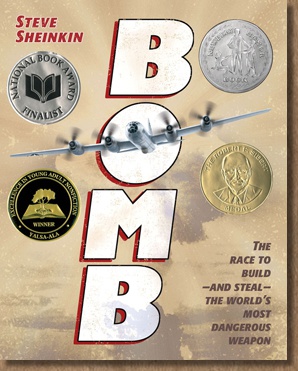
Review: Bomb: The Race to Build - and Steal- The World's Most Dangerous Weapon by Steve Sheinkin

Sheinkin, Steve. (2012). Bomb: The Race to Build - and Steal- The World's Most Dangerous Weapon. New York: Roaring Book Press. 266 pages. ISBN 9781596434875.

Awards/Selection Lists:
-Newbery Honor Book
-National Book Awards - Finalist
-Robert F. Sibert Award
-YALSA Award for Excellence in Nonfiction
-Bank Street Best Children's Book of the Year
 -Washington Post Best Books of the Year
  -VA Jefferson Cup Winner (Older Readers)

 -NBA Young People's Award Finalists 2000-2013


Author's Website: http://www.stevesheinkin.com
Brief Summary:  In 1941, when the Japanese attacked Pearl Harbor, the United States entered into the second world war, a war that threatened to engulf the entirety of Europe and Asia, and certainly affected every country on the globe. As the war got worse, and new types of brutal warfare emerged, a previous accidental discovery led to the greatest race, the race to end the war by creating the world's first atomic bomb. The only question was, who was going to get there first.
 
With allies fighting against each other, Norwegians being trained for secret spy missions to cripple the German's efforts, KGB blatantly recruiting in the United States, and the FBI trailing them all, a group of scientists were rounded up and brought to Los Alamos, New Mexico, where the American's effort to stop the war truly gained speed. But would it be enough and who were these men and women willing to risk everything, to create the impossible?


Personal Reaction: As with all Sheinkin's books, I couldn't stop turning the pages. Once again it felt like I was watching an action/spy thriller, rather than reading non-fiction. Being a huge history lover, particularly in regards to World War II, I have always been curious about the Manhattan Project and the nuclear physics that went into making the atom bomb but Sheinkin explained more about nuclear physics and fission by the time I got to page 82, than 12 years of science classes did! I was flabbergasted that not only was I reading this exciting true story of espionage, FBI agents, covert operatives, cutting edge science and the tools to stop the war, but I finally understood how these things worked and saw the faces of the people who made it happen, in the pages of this book. I found myself wondering what kind of security clearance Sheinkin had, and then realized, the man is just a superb research and an even better story teller.


Front/Back Matter: Preliminary title page, photo of an atomic bomb, title page, copyright page with dedication, table of contents, prologue,source notes, quotation notes, acknowledgements, photo credits, index.


Content Evaluation: (Same evaluation as previous title )One of the things I love about Steve Sheinkin's books is that he incorporates a lot of citations and first hand accounts, and more importantly, tells you where he got the information! So many other non-fiction writers completely skip over this part. Not only does he do this in text, but he provides a distinct quotations index by chapter and includes a detailed index, which allows for greater in-depth research and additional related reading on the subject. He even recommends books to start from. His enthusiasm is contagious and all the extra detail work shows, not only a great deal of research, but a great deal of thought and credibility. I can't wait to read more and I particularly liked the acknowledgement, which explains how the author developed the concept for the book.

Pages

Search

Copyright Text