Showing posts with label Biographies. Show all posts

Friday, May 9, 2014

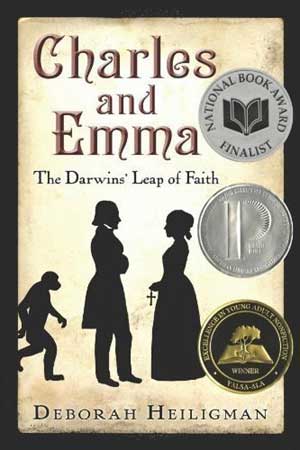
Review: Charles and Emma: The Darwins' Leap of Faith by Deborah Heiligman

Heiligman, Deborah. (2009). Charles and Emma: The Darwins' Leap of Faith. New York: Henry Holt and Company. 268 pages. ISBN 9780805087215

Awards/Selection Lists:
- Printz Honor 2010
- National Book Award finalist 2010
- L.A. Times Book Prize Young Adult Literature Finalist
- YALSA Excellence in Nonfiction 2010
- CCBC Choices List 2010
- Oprah's Book Club 2010 Kids' Reading List: 12 and Up
- New York Times Editor's Choice

Brief Summary:  Through and through, this is the love story of Charles and Emma Darwin, literally kissing cousins who married and had a typical Victorian family, typical except that Charles was shaking up the world by redefining the world's view of creation, nature and the origin of man. Being mildly spiritual, where his wife was incredibly devout, after losing her sister, it became a gulf between then, that they had to span by a leap of faith. Together they endured tragedy, controversy, devastation, ill health, strife, and Emma's growing concern that she wouldn't meet her beloved husband in the after-life, yet they still came out together, still in love and still devoted, with a good tale to tell.

Personal Reaction: I had a difficult time finishing this book. In fact I had to pick it up and put it down twice. While the story of Charles and Emma Darwin is really interesting, I was constantly distracted by the constant interference of Christianity in their story. I understand the context of this element. In England, during the time period, it was extremely common for Victorian women to be incredibly devout, and for religion to rule the roost, and also I understand the strife and heartache it caused Emma. However, at some point during the story, it, and the difference between their two faiths, started to sound more like a nagging presence rather than an obstacle to be overcome and I found myself annoyed. I wanted to learn more about their dynamic, the trials and tribulations they went through, his work, his family, and while I understand that religion and the moral views of the time period were intertwined, I wish they hadn't upstaged his incredible journey.
 
Front/Back Matter: Title Page, copyright page with dedication, table of contents, foreword, content, acknowledgements, family trees, source notes, selected bibliography, index.
 
Content Evaluation: The tone could be a little dry, though certainly you can tell that the author was interested in her subject. While a selected bibliography is less superior than a full one, the source notes, which take up more than 14 pages, are excellent, and arranged by page number and occurrence. I would have liked to have seen more illustrations and photos of the Darwins and Charles' work. I think it would have helped carry the story and immersed the reader in the world.


Wednesday, May 7, 2014

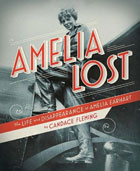
Review: Amelia Lost: The Life and Disappearance of Amelia Earhart by Candace Fleming

Fleming, Candace. (2008). Amelia Lost: The Life and Disappearance of Amelia Earhart. New York: Schwartz & Wade. 128 pages. ISBN 9780375841989

Awards/Selection Lists:
- Nonfiction titles from ALSC Notable Books lists 2002-2013
- Bulletin of the Center for Children's Books, starred review
- Golden Kite Award for Nonfiction, 2012
- Horn Book, starred review
- Kirkus Reviews, starred review
- School Library Journal, starred review

- Richie's Picks


Author's Website: http://www.candacefleming.com

Brief Summary:  Most people know of the amazing story of Amelia Earhart, the first woman to cross the Atlantic, lost of her world hopping trip across the equator, with her troubled but brilliant navigator, Fred Noonan. There have been numerous books over the years speculating over the why and the how but this is the first book I have read that actually chronicles the life, from beginning to end, and nature of Amelia Earhart. A tomboy, a student, a nurse, a social worker, a sister, a daughter, a firecracker, a pilot, a wife.....she was many things and she led a colorful life and broke through social barriers with a finesse that continues to inspire generations of women. She wanted to be free, she wanted to be happy, and no one was going to get in her way.

Personal Reaction: I really, really enjoyed this book. Earhart has been a favorite subject for me since I was child. I grasped onto characters who refused to be pushed around and hide who they were, who bucked against the system to pave the way for future children to find their true paths, hopefully with less discrimination and hardship. This book on Amelia's life is the most complete, compassionate, personal I have read. There are so many photos and accounts, personal details that many others leave behind that really let you connect with her character, her choices and her driving force. I particularly like the interspersed "special sections" which recount first hand accounts of people, many being children, who believe they heard some of Amelia's final words or discovered her location, though no one would listen.

Though her death was incredibly sad, she left a legacy, and through the story that Candace Fleming weaves of her life, we can really understand what a brave and formidable woman she was.
 
Front/Back Matter: Title page, copyright page, acknowledgments, contents, foreword (Navigating History), content, bibliography, "Finding Amelia on the web" sources notes by chapter, picture credits, index.
 
Content Evaluation: This book is very well organized, with a lot of source notes (which I love, it always makes the book easier to believe in), and fantastic resources. There are hundreds of photographs included, but they are organized in a way that doesn't detract from the story, but rather helps carry it and form attachment. The tone is strong, factual, but compassionate and it is a great, and fast read.


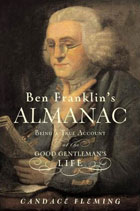
Review: Ben Franklin's Alamanc: Being a True Account of the Good Gentleman's Life by Candace Fleming

Fleming, Candace. (2003).Ben Franklin's Alamanc: Being a True Account of the Good Gentleman's Life. New York: Atheneum Books for Young Readers. 119 pages. ISBN 0689835493

Awards/Selection Lists:
- Richie's Picks
- ALA Children's Notable Book
- ALA Best Book for Young Adults
- Association of Booksellers for Children Fall Favorite 2003
- Book Links Best Book 2003
- Booklist Top ten Biography for Youth, 2003
- CCBC Choices 2004
- Children's Literature Choice 2004
- Great Lakes' Great Books Nominee 2005
- James Madison Award Honor Book
- Jefferson Cup Honor Book (Virginia Library Association) 2004
- Junior Library Guild Selection
- Maine Student Book Award Nominee 2004-2005
- NCSS-CBC Notable Social StudiesTrade Book 2004
- New York Public Library Best Book for Reading and Sharing, 2003
- New York Public Library Best Book for the Teen Age, 2004
- Parents Choice Gold Award Winner
- Publishers Weekly Best Book of 2003
- Riverbank Review Children's Book of Distinction 2004
- School Library Journal Best Book of 2003
- Washington D.C. Capitol Choices Book 2003


Author's Website: http://www.candacefleming.com/

Brief Summary:One of the founding fathers of the nation, Benjamin Franklin is well known, and his accomplishments well documented. Laid out in chronological order, Fleming leaves no stone unturned to reveal Franklin's tenacity, ingenuity, curiosity and his utmost desire to do right by his country, his children, and those he served, by improving, doing, pushing the envelope and not being afraid to offend those in power by being honest, just and proud.

Along with his innovations in his electrical experiments, instituting state schools, libraries, fire brigades, becoming first Postmaster General, being a member of the Continental Congress, helping write the Declaration of Independence, he was a skilled diplomat, a lover, a writer, a man who believed less in organized religion and more in the spirituality of doing the right thing and being chased by the consequences throughout subsequent life-times. He was a complex and interesting character whose humanitarian efforts are often outweighed by the extravagances of his later diplomatic years in France, in part due to the outrage of John Adams wife. Nevertheless, he remains, one of America's most spectacular historical figures, with much more to tell.
 
Personal Reaction: I won't lie, I had a hard time getting through this book. I am very interested in the content, and there is SO much information that I had not previously read on Franklin. You really get a sense of his desire to help his fellow man, of his humility, and his curiosity through Fleming, but it is a bit overwhelming being crammed in small print into 119 pages. Also, while there are many illustrations, everything is in black and white and made to look like an old fashioned newspaper page, which I understand the desire for. However, it makes it difficult to stay focused on the content as there is no color to relieve the eye and offer excitement and a way to really connect with Ben's character.
Front/Back Matter:Title page, copyright page, table of contents, foreword, chronology, content, bibliography, picture sources, additional resources (one page for books, another for websites), index.

Content Evaluation: Very well informed and well documented, the content is extremely fact heavy. I would have liked to have seen a more personal narration, some way to connect and empathize with Ben, rather than just being told about his life. The use of color and a different format might lead to a better review of this book. I think I will attempt to re-read it for leisure, to re-assess if my perceived time constraint caused me to be less entertained by this book. However, its relative dryness is one of the things I dread most. Hundreds of tiny stories inserted into different frames on the page also make it difficult to keep the chronology straight. Still, as I said, I'm willing to give it a second chance.


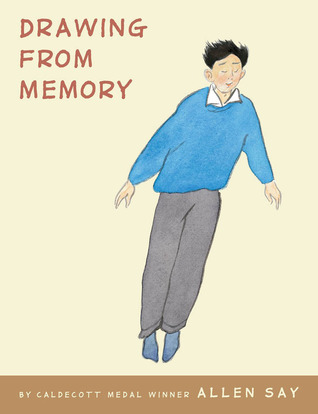
Review: Drawing From Memory by Allen Say

Say, Allen. (2011). Drawing From Memory. New York: Scholastic Press. 72 pages. ISBN 9780545176866

Awards/Selection Lists:
- Nonfiction titles from ALSC Notable Books lists 2002-2013
- Richie's Picks
- Siebert Honor


Author's Website:http://www.houghtonmifflinbooks.com/authors/allensay/

Brief Summary: Allen Say is an award winning, Japanese born illustrator and writer who led a very interesting and independent life, determined to become a cartoonist, seeking out his mentor, his sensei, on his own at the tender age of 13, while living on his own and attending school. Later, he moves to America with his estranged father, to live his dream, but the relationship with his sensei, and what he has learned about drawing as seeing and painting as writing, stays with him forever, as this memoir to his great teacher proves.

Personal Reaction: I adored this book. I love Japanese culture and this book reads an awful lot like a lot of the literature I have read from that area. It may seem a little choppy, and some of the content is told with pictures instead of language, which could be why this is listed in our OPAC as a graphic novel, regardless of the fact that it is covered in photos and cartoons, but I think that it fits very well with the storyline and the geography. Say led a very interesting life, and it is amazing to see the amount of independence post war Japan allowed him, and never thought twice about. Even with his father, his grandmother, and some teachers telling him he would never amount to anything as an artist, he pursued his passion, encouraged by his sensei, 2 teachers and a few friends to become one of the most celebrated talents.

Personally, I think what I love most about this book is that I always wanted to be an artist, but was always told that it wasn't lucrative enough to be an occupation, and then the time I could have used to train and perfect a craft was wasted, as it became a sometime hobby, and one that I often hid from others. I really take Say's story to heart because he pursued his passion to the very end and lived his dream. Like those people he saw in Tokyo that lived and died in offices, I lived that way, and I would prefer to live like Say, following his example. It makes you wonder, is it ever really too late?
Front/Back Matter: Title Page, main page, copyright page, dedication, content, author's note.

Content Evaluation: As stated above, the tone is a little choppy, but very appropriate for a Japanese styled book and I think it carries the story, very well. The photos and illustrations are plentiful, the language easy to absorb and the author's note helps tie it all together, really identifying the purpose of this book, to honor his sensei.


Review: Raggin' Jazzin' Rockin': A History of American Musical Instrument Makers by Susan VanHecke

VanHecke, Susan. (2011). Raggin' Jazzin' Rockin' : A History of American Musical Instrument Makers. Honesdale, Pennsylvania: Boyds Mills Press, Inc. 136 pages. ISBN9781590785744

Awards/Selection Lists:
- Nonfiction titles from ALSC Notable Books lists 2002-2013


Author's Website: http://www.susanvanhecke.com/

Brief Summary: Did you know that Avedis Zildjian was originally a candymaker, his namesake the original maker of the cymbal 300 years previous, in Turkey? Leo Fender was a radio repairman,  and Laurens Hammond, whose name is found on grandma's classic organ in the living room, invented 3-D glasses! Men like this weren't necessarily music makers themselves, but they forever changed the face of American music by their innovation and imagination just as much, and in some cases more, as the musicians chronicled in this book, who took a chance and improved the profession that they loved, while starting businesses that would become household names.

Personal Reaction: I love to heard the history behind instrument makers, and the effects that they had on music of the day. There is a lot of music history in this book, packed between the stories of instrument makers, that makes this book dual purpose. The tone is charming and personable, with a lot of excellent pictures and illustrations. I particularly like the story of Heinrich Steinway (formerly Steinwegs) making pianos in his kitchen, and how he literally changed the shape of the piano, as we know it today, his family even building their own concert hall so that musicians could exhibit their talent, and the instrument simultaneously.

Did you know that during World War II they actually stopped making pianos and started making airplanes, and even the great brass horn maker Conn was making military navigation instruments?! Martin, Fender, Ludwig, Moog...these men are legends in the industry, developing innovations, techniques and instruments of distinction for decades and even centuries, and all are covered in this book as well. No matter where you look, these folks survived tragedy, death and the odds to bring music and their dreams to the American people, and people across the world really. It's also interesting to note that MANY of these incredible artists, had families that immigrated from Germany.

The book is also made all the better because each purchase goes toward continuing music education in schools.

Front/Back Matter:Title Page, copyright page, table of contents, introduction, content, "A Closing Note", Notes (including sources), index.

Content Evaluation: The content in this book is amazing. Stashed in the margins and between photos and histories of these famous instrument makers are the types of music and big names in the industry who influenced, or were influenced, by the instruments and makers themselves, showing how the world and industry changed over time, and how one development influenced the other in a symbiotic relationship.

There are a phenomenal amount of resources included, in additional to the basic bibliography, and quote sources are listed by chapter, so it is easier to believe in the authenticity and accuracy of the information presented. The historic photographs and illustrations really carry along the story and make it more exciting that the title could possible suggest. It can get a little long for those not terribly interested in the subject, and even I had a hard time staying interested by the time I reached my favorites (Martin and Fender), but I highly encourage the reader to wade through each chapter. You'll find some amazing stories of perseverance, tradition and innovation.

Tuesday, May 6, 2014

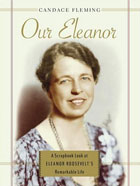
Review: Our Eleanor: A Scrapbook Look at Eleanor Roosevelt's Remarkable Life by Candace Fleming

Fleming, Candace. (2005). Our Eleanor:A Scrapbook Look at Eleanor Roosevelt's Remarkable Life. New York:Atheneum Books. 192 pages. ISBN 9780689865442

Awards/Selection Lists: 
- Nonfiction titles from ALSC Notable Books lists 2002-2013
- Richie's Picks 
- ALA Notable Book
- Best Book for Young Adults
- Jefferson Cup winner,Virginia Library Association
- Junior Library Guild Selection
- New York Public Library 100 Titles for Reading and Sharing 2005
- Oppenheim Toy Portfolio Gold Medal Winner
- Parent's Choice Gold Medal
- Publishers Weekly Best Book 2005
- School Library Journal Best Book 2005


Author's Website: http://www.candacefleming.com

Brief Summary:  Most people know of Eleanor Roosevelt's generous and charitable acts, her contributions toward making the United States a better place during her husband, Franklin D. Roosevelt's presidency. What they may not know is that she came from an unhappy childhood, where the seeds of insecurity were planted that would haunt her the rest of her life. From a cruel mother to a drunken father, a harsh grandmother, wild and crazy aunts and uncles, Eleanor would eventually find her place in the world, and find where her true power and happiness came from, making other people's worlds better; making a difference in the lives of those who truly needed it, and it was her inspiration and intelligence that led to many of the reformations that swept the country during FDR's presidency, though after his death, she felt she could finally be her true self, and as she said "The story is over." But was it?

Personal Reaction: I've always thought of Eleanor Roosevelt as a great lady. I had heard rumor of FDR having an affair, but Eleanor's relationship with FDR always seemed so strong in everything I had read, and I do believe that he would not have been as successful a president if she had not had the strength to stay with him, though the love and trust had gone from their marriage. They truly became partners and that is a fortitude I am not sure I could have mustered. She was a lonely child and crazed attention, and I feel I can relate to her in so many ways. She wanted to be loved, she wanted to be liked, and part of that lead her to that feeling of fulfillment she finally found in helping the less fortunate who simply wanted a better life for their children. I think, in a way, Mrs. Roosevelt was working toward making sure that every child she touched had a better, more secure life, even if it was simply emotionally, than she had. We all want to provide a better world for our children, and it seems as if Mrs. Roosevelt was finally coming out of her shell and playing mother to the world. She is one of those characters from history that I wish I could have befriended. I think we would have had a lot in common.
 
Front/Back Matter: Title page, copyright page, acknowledgments, table of contents, foreword (a personal note), chronology, family tree, resources (More about Eleanor), picture credits, source notes.

Content Evaluation: The layout is very logical and the tone intriguing. There is a lot of information to sort through, but I found the information interesting, particularly the passages on her later life, where I saw the issues from her past being resolved in the present, through others. The sources and resources are plentiful for further exploration, and the chronology and family tree make it easy to keep things in order, and the relationship between Teddy Roosevelt, Eleanor Roosevelt and Franklin Roosevelt apparent. Overall, a great history of an amazing lady.

Review: Genius: A Photobiography of Albert Einstein by Marfe Ferguson Deland

Delano, Marfe Ferguson. (2005). Genius: A Photobiography of Albert Einstein. Washington D.C.: National Geographic Society. 64 pages. ISBN 0792295455

Awards/Selection Lists:  
- ALA/Book Links Best New Books for Classroom
- Outstanding Science Trade Book for Young People
- Notable Children’s Book of Jewish Content-Association Of Jewish Librarie
- Orbis Pictus Honor Book
- New York Public Library Books for the Teen Age
- Nonfiction titles from ALSC Notable Books lists 2002-2013

Author's Website: http://marfebooks.com/

Brief Summary: As one of histories most recognizable figures, Marfe Ferguson Delano profiles the life of scientist and humanitarian, Albert Einstein, from his beginnings in German, Italy and Switzerland, to America, his 2 marriages, 2 sons, and 2 step-daughters and puts to rest the unfounded rumors that Einstein took bad marks in school due to lack of proficiency, his involvement in the Manhattan Project and that his life as a patent clerk was all drudgery. As one of the world's most brilliant thinkers, and the father of quantum physics, Einstein maintained his childish enthusiasm, his curiosity about the world and his desire to make it a better place, inspiring generations to come, even landing on the cover of a very famous magazine at the turn of the 21st century.

Personal Reaction: Albert Einstein is one of my favorite characters from history, notably because he was what people considered to be relatively eccentric. He was brilliant, tempestuous and precocious as a child, but loving, with parents who encouraged his independence and imagination. As an adult he was a pacifist, a thinker, full of imagination and curiosity, following love and wanting to make the world a gentler place. As he grew older his appearance became more disheveled,  he never wore socks, and he was never more loved or respected as a hero, even by people who had no idea what his theories and articles meant. Above all, I think I respect not only his intelligence but his gentle nature, a lover not a fighter. You don't hear of many people who made an indelible mark on the world who follow that philosophy.

While the book was brief, it gave a good overview of his life, from birth to death, though the chapter on his death seemed the most brief. It is interesting to me to note that the condition he died from, an abdominal, aortic aneurism is the same genetic condition that my uncle died from less than a year ago. I think he would have been pleased to know that he had something in common with such a similarly eccentric spirit. While I would liked to have seen more in-depth information, I think this is a great start for those still testing the world of non-fiction and biographies, where excessive length can cause disinterest. I never lost interest, and it left me wanting more, which is often the hallmark of a great writer.

Front/Back Matter: Brief title page, full title page, copyright page with dedication, quote, foreword, content, afterword, chronology, resources, credits, index.

Content Evaluation: The credits are listed chronologically but in an odd configuration that can make it difficult to determine what goes where. However, when quotes are used in the text, it is often followed by a footnote or reference to the original source as well, which helps. The additional resource page is helpful, as is the information on the Albert Einstein Archives. I would have liked to have seen more content, as mentioned above, but the overview of Einstein's life is more appropriate for Young Adults still venturing into the genre to test the waters. It's not too overwhelming and of good overall length, so that I would not hesitate to recommend this for older tweens as well.

Review: Claudette Colvin: Twice Toward Justice by Phillip Hoose

Hoose, Phillip. (2010). Claudette Colvin: Twice Toward Justice. New York: Square Fish Publishing. 160 pages. ISBN 0312661053

Awards/Selection Lists:
- Newbery Honor Book
- Robert F. Sibert Award Honor
- YALSA Award for Excellence in Nonfiction Finalist
- Jane Addams Children’s Book Award, Honor
- ALA Best Book for Young Adults


Author's Website: http://philliphoose.com/

Brief Summary:  Nine months before Rosa Parks made her immortalized stand against segregation on a Montgomery, Alabama bus, a teenage girl in the same city was arrested and jailed for refusing to give up her seat to a white person on a bus. Almost lost to history because she was not considered an appropriate role model for a civil rights movement, it was the court case that she helped bring to the courts of Alabama that ended segregation, though she would tell you, the fight's not over yet.

Personal Reaction: This account of Claudette Colvin's story, in her own words and Phillip Hoose's is fantastic. I could not believe that a story like this had not been presented in school as part of our study of the civil rights movement. This girl had guts, even as a teenager, and dared to take a stand to say "This is not right." Hoose found her story when he was writing "We Were There, Too." and I am so glad he did. We get to hear from Claudette herself the ups and downs, the emotions and thoughts running through her head from the start through the end, why she believes Rosa Parks was a better role model, but also where injustice reined, even in the civil rights movement she helped found with her own sacrifice. It is personal, emotional, brave, outstanding and you can really tell how passionate Hoose was when telling her story. Imagine if we had lost her story  forever. Now her story can help children of all ages learn to stand up for what's right, to be brave, and above all, to make your voice heard.
Front/Back Matter: Title page, copyright page, table of contents, content, author's note, bibliography, notes, acknowledgments, picture credits, index

Content Evaluation: Hoose's tone was enthusiastic, though the format was sometimes a little choppy. His notes, bibliography and picture credits were extensive, though he notes that some citations may be missing. As with most of his books, his resources are excellent, thorough and plentiful, allowing for substantial further research, and offering legitimacy to any information presented as facts.

Saturday, April 26, 2014

Review: The Trouble Begins at 8: A Life of Mark Twain in the Wild, Wild West by Sid Fleischman

Fleishman, Sid. (2008). The Trouble Begins at 8: A Life of Mark Twain in the Wild, Wild West. New York: GreenWillow Books/Harper Collins. 224 pages. ISBN 9780061344329
Awards/Selection Lists: 
- Nonfiction titles from ALSC Notable Books lists 2002-2013

- Richie's Picks- Richie's Picks Nonfiction titles
Author's Website: http://sidfleischman.com/

Brief Summary:  Most people remember Mark Twain, or Samuel L. Clemens, as an east coast and Missouri man, clever and cantankerous, but funny and brilliant. Many people know that he was a river boat captain in his younger days. Some may even know that he worked in many newspaper offices. But what few people seem to know is that Mark Twain had his own Wild West adventure, starting with the journey to Nevada where his older brother became the only Secretary of the territory. What did Clemens think of the Wild West? How did he get on? What is his connection to gold rush fever, California, and the Hawaiian islands? How did these adventures contribute to his becoming a published author? How did they shape the famous man we know of today?

Personal Reaction: As I'm finding with many of the books I am reading for this non-fiction blogging assignment, I really enjoyed this book. Now, I chose this book specifically because Mark Twain is one of my favorite literary and historical figures. He had a notoriously wicked sense of humor, sarcasm and satire, he loved to stir things up and challenged standard notions of righteousness and propriety. He just had to think for himself and be different and that, I admire. He was distinctive and devoted, talented and troubled. He wasn't perfect but he was colorful and brilliant, and his story inspires me and reminds me that it's ok to be different. In fact, it's probably the best thing I can think of.

At first I thought I was keeping in time well enough with the chronology of events, only to read at the end that many of these accounts may have been inaccurate because of Twain's love of embellishment for the sake of a good story. Then I'd shake my proverbial fist at the memory of Mark Twain, while smiling a wry smile,  and I would try to make sense of what happened. Perhaps this is why the author offers so much back matter, to help with the quest. Or perhaps that was Twain's idea all along. "Can't make it easy for 'em, " I can imagine him saying with a wink.
Front/Back Matter: Title page, copyright page, dedication, table of contents, Preface, content, timeline, references (by chapter and page), illustration and photograph sources, bibliography, "The novels and other works", index.
Content Evaluation: By far the most organized and complete set of back matter in any non-fiction book I have read to date, Fleischman was spot on the mark. He makes it easy for anyone to not only check facts, but keep events in order, reference particular time periods, events and topics and provides sources for further review and study. It really speaks to the dedication of the writer to portray events as accurately as possible and to give a complete picture of such a famous man's life.

I like Fleishman's tone because it is humorous and personal, though once you read at the end of the book that the way the events are depicted might not be accurate kind of turns you on your ear, as far as believing in his pure credibility goes. But perhaps he's wanting us to evaluate for ourselves what is factual and what is not. Still, the book is entertaining, informative and I believe accurately portrays the character of Sam Clemens.

Sunday, April 6, 2014

Review: Walt Whitman: Words for America by Barbara Kerley

Kerley, Barbard. (2004). Walt Whitman: Words for America. New York: Scholastic Press. 56 pages. ISBN 0439357918.

Awards/Selection Lists: 
-Sibert Honor Book
-California Book Award
-ALA Notable Book
-Best Children’s Books -- Publishers Weekly
-Best Illustrated Books -- New York Times
-Best Book Award -- Oppenheim Toy Portfolio
 
Author's Website: www.barbarakerley.com

Brief Summary:  Walt Whitman is known far and wide as one of America's greatest poets, characterized by his long white beard and wavy locks. What most people don't know is that Walt Whitman was sympathetic, perhaps even empathetic, of the plight of the down trodden, those souls who suffered and persevered though all odds were against them, and to bring their struggle and their glory to light, he wrote about them, in verse, in notebooks, and eventually typeset them into books, wherever and whenever he could. When the Civil War threatened to take his brother, he travelled to the camp to tend to him, as he tended to other wounded soldiers in hospitals where they convalesced. He tried to cheer their spirits and rally them, singing the praises of American, and bringing his words to every person. This was his passion, to not only make the world better, but to make it equal.
Personal Reaction: I liked this book, though it is more than likely a little short for the requirements of this assignment. I also loved the illustrations but felt that as grandiose as they were, there should have been more text to back them up. Walt Whitman is a fascinating and passionate character, a gentle soul who wanted nothing more than to make people feel better. He is one of the best poets ever known, a man of the people, having grown up in Brooklyn, and living of limited means. He was accessible, he was almost valiant and I think, while this book is good, particularly so for those with limited attention spans, I wanted to learn more, and I was disappointed that the book focused primarily on the influence of the war, and little else.
Front/Back Matter: Front cover, dedication page, title page, content, author's note, illustrators note, a note on poems, selected poems, sources and copyright page.
Content Evaluation: The focus of this book was very obviously on the full page illustrations. While they were beautiful, they also distracted the reader from the text, which I thought could have been more comprehensive. While there was a lot told about Walt Whitman, it almost all circled around his involvement in the Civil War, and as we all know, there is much more to learn about a man's life than once story. The selected poems are a nice element, so that the reader can get to read the full passages described in the book, now knowing what the backstory was, but the bibliography (sources) is very small, and leaves little for further exploration.

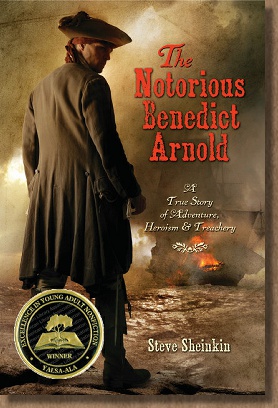
Review: The Notorious Benedict Arnold: A True Story of Adventure, Heroism & Treachery by Steve Sheinkin

Sheinkin, Steve. (2010). The Notorious Benedict Arnold: A True Story of Adventure, Heroism & Treachery. New York: Roaring Book Press. 337 pages. ISBN 9781596434868.

Awards/Selection Lists:
- YALSA Award for Excellence in Non-fiction
-  Horn Book Award
- Beacon of Freedom Award
- New York Charlotte Award Master List
- Horn Book Magazine Fanfare List, Best
of 2010
- School Library Journal, Best Children’s
Books of 2010


Author's Website:
http://www.stevesheinkin.com/ArnoldBook.html

Brief Summary:  The name "Benedict Arnold" has become synonymous, for more than 200 years, with school children, as a term for a cowardly, backstabbing traitor, even for those who know nothing about the man himself. Steve Sheinkin takes his personal passion for this story and turns our preconceptions on their ear. Benedict Arnold, the second child of his family to bear this name, was an impetuous war hero, brave and rash, who bucked authority and was seeking to restore his family's name and fortune, before he was ever a traitor. He fought duels, wrote love letters, was wounded in battle more than once,  owned a mercantile, studied apothecary, went to private school, but also worked to support his parents and siblings. Who knows...if only one detail had been different during the course of his life, perhaps Benedict Arnold would have become synonymous with valor and courage, but therein lies the plot twist in this better-than-fiction tale of how a battle hero General goes from a physical representation of the ferocity and independence of a fledgling nation, to a worn and destitute man, despised by the country he betrayed.

Personal Reaction: I really enjoy Sheinkin's writing style. He makes non-fiction seem like an adventure novel because he has such passion for his subjects and is a superb story teller. He keeps the reader interested and turning the pages. This is what great non-fiction should all be like, entertaining and truthful.
 
I learned more about Benedict Arnold in 200 pages of this book than I did in 12+ years of school. I had no idea he was a war hero, or impetuously led himself and other men into battles, almost like a sport. I had no idea he had been wounded, not once, but twice in the battle for independence and I had no idea whether or not he had actually been captured after his treason. Sheinkin tells all this and more, giving us the reason for the betrayal, and pointing out that why it may have been wrong, it also could have been avoided.

Front/Back Matter: Title page, copyright page with dedication, table of contents, source notes, quotation notes, index.

Content Evaluation: One of the things I love about Steve Sheinkin's books is that he incorporates a lot of citations and first hand accounts, and more importantly, tells you where he got the information! So many other non-fiction writers completely skip over this part. Not only does he do this in text, but he provides a distinct quotations index by chapter and includes a detailed index, which allows for greater in-depth research and additional related reading on the subject. He even recommends books to start from. His enthusiasm is contagious and all the extra detail work shows, not only a great deal of research, but a great deal of thought and credibility. I can't wait to read more.

Friday, March 21, 2014

Review: Vincent Van Gogh: Portrait of an Artist by Jan Greenberg and Sandra Jordan

Front Cover
Greenberg, Jan, and Jordan, Sandra. (2001). Vincent Van Gogh: Portrait of an Artist. New York: Delacorte Press. 132 pages. ISBN 9780385328067.

Awards/Selection Lists:
- Robert F. Sibert Honor book
- ALA Notable Book
- ALA Best Book for Young Adults
- Common Core State Standards Text Exemplar

Author's Website:
 
Brief Summary:  One of the most famous painters in history, this chronological account of the life and work of Vincent van Gogh begins with the birth of Vincent to Dutch Reverend and his wife. The first live child, but second of his name, to arrive in the household, Vincent's life never seems to travel in a straight line. Whether he decided to teach, to preach, or to draw and paint, he did so with relish few others could match, and with a fragility, humanity, and eccentricity unsurpassed by modern artists. Contemporaries of Gaugin, Toulouse-Lautrec, Manet, Monet and the Impressionists, Vincent's relationship to art, his family, and the world around him would lead to emotional masterpieces the world has not seen since, nor are they likely to.

Personal Reaction: Vincent van Gogh holds a special place in my heart, much like Einstein, da Vinci and P.T. Barnum. Often misunderstood, but highly emotional and sometimes intentionally reclusive, these artists and larger than life celebrities dared to live life outside the lines, creating a brighter, more vivid, compassionate and imaginative world than they came from. Van Gogh was often portrayed as troubled, mentally ill, and unstable. However, while not ignoring these facts, this biography places him squarely in the world of the attainable artist, the sensitive fellow searching for his place, his talent and his legacy for the world. Instead of being simply insane, the author shows how it is possible that, due to emotional stress (something that can be debilitating in highly sensitive individuals), poor diet, and partaking of the ever popular toxic absinthe, Vincent may have had epilepsy, contributing to some of his more strange behaviors. I would have liked to have seen a little more information on the side effects of prolonged absinthe usage, as it has been known to cause hallucinations, of which it was said Vincent suffered, but overall, the authors presented Van Gogh as a true person, rather than a commodity, and I think that is difficult to portray in non-fiction, while attempting to maintain facts.
 
I appreciated that the authors often fit his more famous works into the timeline of events of his life, to help the reader understand the factors that influenced his work and also the connection to his family, particularly his father, mother, and brother Theo, who financed him, both as a brother and an art dealer, for the majority of his life. Overall, I was amazed at the depth of knowledge explored on Vincent in this short 132 page work. A definite good read, though a little dry at points. It sill makes me wish I could paint the way I feel, like Vincent strove for so long to do.
 
Front/Back Matter: Front cover,  Title page, Copyright Page, Dedication, Contents, Map, Prologue, Chapters from birth through death, Postscript, Biographical Time Line, Museum Locations, Glossary of Artists and Terms, Notes, Index, About the Authors.

Content Evaluation: One problem I always have with children's non-fiction is the lack of accountability and citation of sources. The authors speak a lot to Vincent's emotional states, and those of his family and friends. Certainly some of it can be assumed due to the tone of letters and correspondence, but with no first hand accounts, how can this be positively assumed? However, the time line, postscript denoting Vincent's sister-in-law preserving his works and letters for display, the glossary and artist listing, as well as museum location lends an air of credence given the amount of research necessary to acquire this information. The Notes are where the authors gives their sources, chapter by chapter, and lends more authority to the research.

Thursday, March 20, 2014

Review: Persepolis: A Story of Childhood by Marjane Satrapi

Front Cover
Satrapi, Marjane. (2003). Persepolis: A Story of Childhood. New York: Pantheon Books. 160 pages. ISBN 9780375714573.
 
Awards/Selection Lists:
 - ALA Alex Award
 - YALSA Best Books for Young Adults
 - Booklist Editor's Choice for Young Adults
 - New York Public Library Books for the Teen Age
 - School Library Journal Adult Books for Young Adults
 
Author's Website (Agent): http://barclayagency.com/satrapi.html
Brief Summary: A memoir of the author's childhood, beginning at 10 years old, in the year 1979, the beginning of the Islamic Revolution in her home country of Iran and spanning the Shah's removal, and the war with Iraq, this black and white graphic novel presents a very approachable account of a very troubled and gruesome time. Luckily, for the outspoken and independent Satrapi, her parents were progressive and encouraged her free thinking, going so far as to send to her Vienna at the age of 14 to help her escape the oppression in her home country, in order to give her a better life. This novel explores her inner thoughts, her outer influences, dangers and traumas, as well as the effect and reactions of her loved ones.
 
Personal Reaction: I was really surprised in that I loved this book. I had been drawn to it in the past because it is a graphic novel, but passed it up upon learning it was a non-fiction account of a childhood in turbulent and violent Iran during the 1980's. I can recall hearing some terrible things about this time and this country, and the atrocities against girls and women during my childhood. Satrapi does tell of these atrocities, to inform the reader and be true to her own story, but she does it from the perspective of a 10-14 year old girl, and somehow, while it can be hard to understand, it is not presented in a way that would turn off or traumatize the reader. It's done in an honest but understanding manner and I think that, through the telling of her own thoughts and mental state, her attempts at pushing the boundaries, her parents' difficulties and in their successes and support, it becomes encouraging and an eye opening look at how one girl can make a difference. This girl, the author, now a grown woman, is making her difference by telling her story, and hopefully, opening the world's eyes to what goes on behind closed borders and showing that with perseverance and love, life goes on.

Front/Back Matter: Title page, Copyright Page, Introduction, Chronological author account, Credits.
 
Content Evaluation: Overall, I would say this is a superbly written book. It is emotional without being assumptive, and truth without necessarily pointing a finger. She never comes out and condemns one ideology or the other. She simply shows the consequences, how people felt, their reactions, and (now) well documented crimes that are committed when powerful people think no one is watching. I kept waiting for blame to be issued, but throughout the entire novel, while I understood where the author's parents' loyalties lay, she never once came out and said one person was wrong over the other, and that is beyond commendable. She let their actions speak louder than blame ever could.

Thursday, February 27, 2014

Review: The Great and Only Barnum: The Tremendous, Stupendous Life of Showman P.T. Barnum by Candace Fleming

Fleming, Candace. (2009). The Great and Only Barnum: The Tremendous, Stupendous Life of Showman P.T. Barnum. New York: Schwartz & Wade Books. 151 pages. ISBN 9780375945977

Awards/Selection Lists:
-ALA Best Books for Young Adults 2010
-ALSC Notable Book 2010
-Booklist Top Ten Biographies for Youth 2010
-Kirkus Reviews Best Young Adult Book 2009
-New York Public Library 100 Books For Reading and Sharing Title
-Publishers Weekly Best Book 2009
-VOYA "Perfect Ten"
-YALSA Award for Excellence in Nonfiction for Young Adults 2010 (nominee)
Brief Summary: P.T. Barnum was arguably the world's greatest showman. No small life could contain him. Amongst his better known accomplishments are the Barnum & Bailey Circus and the P.T. Barnum American Museum, which burned down, not once, but twice, in New York City. But did you know he was also a politician, a humanitarian, a businessman, a church goer, a recovered alcoholic, a husband, an advocate for animal rights, an independent consult for biologists and budding zookeepers, and a father of 4 daughters, full of life and humor until the very end of his 81 years?
Personal Reaction: I LOVED this book, flat out loved it. I relished every page, meticulously examined every photograph, every etching, reread the account of this enigmatic man's life, time and again. It was the perfect length, an upbeat, easing flowing tone, and the illustrations really gave a feeling for life during the subject's time. I believe it to be excellently written!
 
I have a passion for history. I've always had this passion and traditional American forms of entertainment, particularly those appealing and available to the young and old, the poor and the wealthy, have always fascinated me because of their attachment to history and their ability to bring people, from all walks of life, together. You can practically feel decades of smiling faces, curiosity and tradition, palpable in the air at these events. You can imagine yourself in a bygone era, enjoying the simple pleasures, marveling and learning new things, and building memories with loved ones. The one event that immediately might come to mind is good, old-fashioned, American baseball, which is of course, one of my very favorites. The second that comes to mind? The American circus, and no one did the American circus better than the larger than life figure that was P.T. Barnum.
 
Content: Before I read this book, I had heard some things about P.T. Barnum, some good, but many vilifying, without any real documentation to back it up. This always bothered me, as I'm a staunch believer in making my own mind up about people, for where some see little worth, I may see a glittering jewel. I get the feeling that Candace Fleming may have felt the same when she set out to write this book. While she consulted many of Barnum's own documents on his life and business dealings, she also consulted biographies and first hand accounts, stories, legends, and even writings on the ideology of people and conditions of living during his time. I believe this to have created a full, spherical account of his life from all directions, avoiding creating what I term as a "cabochon" effect, that is, the appearing fullness on the top, with a flat and deceptive back. Most people hear of atrocities and animal abuse at circuses, of Barnum as a deceiver and only interested in money. The truth, as Fleming sees it, is much more interesting.
 
On the charge of animal abuses and atrocities, Fleming points out that many of the animals Barnum acquired were exotic, never before cared for in the Western world, and most people in his day simply did not consider collecting them for exhibition to be wrong. In his defense, as his collection expanded and his years went on, he became an invaluable asset to Natural History, Biology and newly established Zoology. He was known as an animal expert, because he had decades of experience feeding, caring for and observing these animals and their behaviors. As he grew older, he began to show empathy for them, building them larger habitats and sobbing over their fates after the last devastating museum fire. When they died, regardless of the cause, he often donated their bodies, skeletons or their taxidermied epididymis' to universities for study, such as Harvard. He kept log books and had specialized railroad cars developed for them, and spoke out in defense of them in public venues and during his tenure as mayor and councilman. When a self-proclaimed animal advocate spoke out against his treatment of his animals, or the tricks they performed, Barnum was completely transparent in his dealings and showed the advocate, publicly, how the animals were in no harm, so much so that, while they butted heads over many years, he grew to have a healthy respect for the advocate's work.
 
On being a deceiver and only interested in money, Fleming shows this simply was not true. Barnum's opinion was that everyone liked a good "humbug", that is, a practical joke, as long as they know they are in on it. People like to be entertained, to hear a good story, to make up their own minds as to what is truth and what is not. He did write letters to newspapers claiming to be other people, to help potentiate the stories of his attraction, but this was in an era where fantastic fiction was more readily reported as fact than actual researched and documented facts. Facts didn't sell newspapers and journalists were not held accountable. When one of these humbugs were discovered, much of the public was delighted at the joke, as they were never malicious. Was it strictly for monetary purposes? Was he trying to make people look a fool to increase his profits? Not exactly.
 
Barnum believed people wanted and needed to be entertained. They wanted to believe in the impossible, in the grand, to escape the mundane qualities of everyday life and dare to dream, just like he did. Did he have an interest in profit making, being a businessman? Absolutely! But no one seems to mention that there is no record of a malicious attempt at making these profits, that he compensated his performers EXTREMELY well, paying for food and board, medical expenses, costuming and generous wages at a time when those who were "different" could be shunned and left to die in the street. Barnum believed that these people were not freaks but wonders, people to be marveled at, respected and exalted. He got them together with the public, and got them talking, lecturing, occupying the same space and he helped them earn a tidy living. He wasn't just about miniature people, giants, dog boys and Siamese twins. He also highlighted and promoted inventions and entertainers of all types to great success, most notably, the singer, Jenny Lind. He had a talent for promotion, for entertaining, for making people happy.
 
Was he perfect? Absolutely not. But he showed a strength of character in the way he dealt with people, helped his community, was passionate about making people happy and owning up to, and correcting his mistakes that was admirable and above all, he was a fighter and a dreamer. Life would knock him down, from the time he was a young boy, and he would get back up and fight harder, make a way for himself and try to make people happy. In doing so, he made himself happy. He had strong relationships and tender feelings, big mistakes, but bigger comebacks, remarkable talents, education and gumption, and a huge concern for his fellow man, but never before have I seen it all laid out, accessible and entertaining as Candace Fleming puts forth in this book.
 
Content Evaluation: It is very obvious that the author exhaustively researched this book. There are so many, what I consider to be, "little known" facts about P.T. Barnum (did you know his name was actually Phineas Taylor, and that he was named after a prank loving uncle, or that he helped establish a library and never did say that famously attributed line of "There is a sucker born every minute"?) that make it plainly obvious that Fleming was determined to tell as much about this man's life as possible. It's very easy to read, with explanations of circus terms, ideologies of the time, and a fantastic Source Note section, laid out by chapter, in addition to an annotated bibliography. I don't recall the author at any time making conjectures about what happened or how someone felt. She is very sure to mention supporting evidence to back up her claims. While sometimes I thought that it might have been an overly positive evaluation of P.T. Barnum, by the end of the book I realized that the negatives were also brought to light, such as his drinking early in his career, being an absentee father, his less than kind verbal attentions to his wife (while he was drinking), his recovery, his bad business dealings, his bankruptcy and more, making the story much more balanced, and again, a much rounder, fuller account.
Sunday, February 9, 2014

Review: Leonardo da Vinci by Kathleen Krull

Krull, Kathleen. (2005). Leonardo da Vinci. [Giants of Science Series].  New York: Viking Kids. 128 pages. ISBN 9780670059201.
Awards/Selection Lists: ALSC Notable Books lists 2002-2013
Brief Summary: A brief but thorough biography of one of the most enigmatic figures of history, focusing on  the circumstances of his life but also of his true passion, and the subject which he contributed most to over the course of his life, Science.
Personal Reaction: I really enjoyed this book. As a matter of fact, I read it in one sitting. Part of this could be due to the fact that Leonardo da Vinci is one of my favorite characters from history. With his talent in art,  inquisitive mind, many idiosyncrasies, distaste for politics, constant observation, private, unobtrusive and playful nature and obsessive genius, there is so much to learn about this man who is so often known for his artwork, but who desperately wanted to be known for his science. It could also be that I find myself identifying with him, with our similar obsession with flight and wings, difficulty focusing and completing one task at a time, observing everything and everyone, finding beauty in infinitesimal details, curiosity about water, nature and how the world works. It could also simply be that Krull relays Leonardo's story with an anecdotal overtone on top of excellent research, poignant details and possible conjectures where information may be missing, that reels in the reader, not only forming an emotional connection, but forcing the reader to ask the same questions that went through Leonardo's mind, "What if?"

Often non-fiction gets a bad wrap, as being dry and stuffy, full of facts and figures that hold little interest. This is definitely not true of this book, or this series. It is engaging, interesting, informative and kept me saying "just a couple more pages" until I found myself at the end of the book wish there was more, though I do wish there were more of the beautiful illustrations. It also tackles the difficult topic of legitimacy, homosexuality and its persecution, which affected Leonardo's life from start to finish. While more conservative readers may find this shocking, I find it to be perfectly appropriate for middle school children and I would be perfectly willing to discuss the topic with readers as young as 8, given the appropriate context.

There are also phenomenal amounts of internet resources indexed in the back of the book, including the following url's, intended to provide the reader with digital copies of Leonardo's codex pages for review.
http://www/anh.org/exhibitions/codex/
http://www.bl.uk/collections/treasures/digitisation.html#leo
Unfortunately, both of these addresses are no longer valid and as of the date of this blog post, new addresses have not been discovered. However, there are many .pdf and .jpg copies of codex pages available using simple internet browser image searches.

Contents: Life in the Middle Ages; being born in Vinci, Italy; parents; being illegitimate; social stigmas; apprenticeship; art; friends; works; budding interest in science; young adulthood; change in political regime and climate; patronage; goals; scientific method; observation; persecution; court trials; living conditions; vegetarianism; codices; influences; later life; death; division of his works.

Content Evaluation: While the content is presented fluidly and in an engaging manner, the author makes many conjectures on the mental and emotion state of her character. While it may be easy to make these inferences, and they may even be accurate, the vernacular used is more geared toward the audience, for entertainment purposes, than information purposes. Also, no citations or sources are listed, though a bibliography is listed at the back of the book. Also, many of the links/resources that she provides for further research are out of date or unavailable. I notice this trend in many children's non-fiction books and believe that perhaps if an opinion is to be stated as fact, a footnote either with the distinction or the source should be included, so as not to come into question the accuracy of the information or the motivation of the author.

Pages

Search

Copyright Text