Showing posts with label WWII. Show all posts

Saturday, August 11, 2018

Review: The Guernsey Literary and Potato Peel Pie Society (Film)


Image result for guernsey literary and potato peel pie society netflixNewell, M. (Director). (2018). Guernsey Literary and Potato Peel Pie Society [Video file]. UK: Netflix. Retrieved August 11, 2018, from www.netflix.com                                                                                                                                                                                                                                                              Awards: None noted....yet.
Once settled in from a long day, late errands, and an even later family meal, I turned on the television, like so many people do these days, to Hulu. Whether due to fortune or fate, playback failed more than once to load "Ghost Adventures," which, while not my favorite, we had been binge watching for lack of other "ghost shows," as my kiddo puts it. So, back to Netflix I went, where the advertising banner across the top of the screen showed a title I remember seeing in my email a day or so ago, "The Guernsey Literary and Potato Peel Pie Society." I recalled the title because, come on. Who wouldn't? It's long, and ungainly and I sort of disregarded it but a little corner of my mind stayed curious. When the quick blurb mentioned the reunion of a number of cast members from the critically acclaimed television program, Downton Abbey, the time was right, my interest was right and I was hooked, ready to press play.

Now a little background, because I did some homework. "The Guernsey Literary and Potato Peel Pie Society" was originally a book, like SO many movies. I used to have a rule where I would always read the book before the movie, but as I've grown, so too has my approach to this. I have decided to read what presents itself to me first, and watch what presents itself to me first, and then go after the media I missed to compare it to the one I came across, while attempting to appreciate each format on its own. After seeing the movie though, I can tell you, I am desperate to get my hands on the book. (Shaffer, M. A., & Barrows, A. (2018). The Guernsey Literary and Potato Peel Pie Society. London: Bloomsbury Publishing.)
Mary Ann Shaffer, from what I read was a librarian, just like me. As strong as her love was for the written word, she longed to write something of her own. A few months after that dream was realized and published, she lost a battle with cancer, and the world lost a great story teller. Mary relied on Annie Barrows to help her complete her vision, when she got sick, and together they created an amazing, deep, heartfelt story of intrigue, humility, romance, healing and redemption. It was the right story, for the right time...at least in my case.
In the wake of World War II, Juliet Ashton (Lily James), like many, has lost everything, her home, but most importantly, her parents...the only family she had. To the naked eye,  she has become a success story, as a celebrated author with a dedicated best friend as a publisher, an increasing bank roll and her dashing, charismatic Yankee fiance. Yet Juliet feels isolated, a drift without a home, without her people. It's an empty feeling that many of us can relate to. In a twist of fate, a man, a farmer, Dawsey (), from the island of Guernsey, located in the English channel between Britain and France, finds a book that once belonged to Juliet, and is still inscribed with an address that allows a letter to find its way to her a twist of fate. The two start a correspondence, bonding over literature and the story of The Guernsey Literary and Potato Peel Pie Society.
The island of Guernsey was occupied by German forces during World War II. They confiscated local livestock, alcohol, luxury and daily goods, imposed a curfew and left the residents in fear. One local woman dared defy them, and brought together her neighbors and friends for an impromptu dinner party, with whatever clandestine foodstuffs they had been hiding or could come up with the materials at hand, like potato peel pie. As the group departed, the majority were confronted by German soldiers who demanded to know why they were out. Under the influence of good times, good company, and homemade gin, they spill out with the explanation that their literary society has just been meeting. When pressed for a name....you guessed it...The Guersney Literary and Potato Peel Pie Society. 
The story of the society and the relationships that grew out of it inspire Juliet to make an impromptu visit to the literary society of this sleepy town, still struggling to regain their footing after the war and some heavy personal losses. She finds, once there, that there are secrets to be unearthed, and a sense of purpose she had been missing. In its arms she slowly finds her place and the faces she feels she already knows, though she'd never seen them before, those of her tribe, her family, not by blood, but by choice and experience, who understand, accept, relate to and love her for exactly who she is, something that not even trying to return to the shiny promises of London and a movie-worthy fiance could pry from her heart. In her journey, she finds what her heart truly needs, her purpose, her spark, her truth...where she belongs and what she must do....she must write and she must, go back.
Bottom line, this movie is a romance. It's also an historical-fiction drama. It was brilliantly directed, acted and produced, from outstanding source material. It hit so many check boxes for me. WWII, check. Fantastic cinematography that capture the natural beauty of the landscape, check. Literary appreciation, check. A story of overcoming struggle, healing and finding your true place in the world, though others may not see the value in it, check. A cast of brilliant actors, check, check, check. 
Michiel Huisman was great in "Game of Thrones", as the warrior and lover of Khaleesi. But I first fell in love with him (so-to-speak) in another television show, "Orphan Black," where again, he was a calm in the middle of the dark storm; as passionate, caring, more-than-meets-the-eye protagonist that you could count on, and who could keep surprising you at every turn...something I definitely have longed for. Then again, I fell for him afterwards in one of my favorite movies called "The Age of Adeline," where he falls in love with a woman who has not aged in more than 60 years, and has a past with his family, that he had no idea about. Again, he is passionate, responsible, kind, funny, genuine, handsome, endearing...man if it's type casting, sign me up. His chemistry with his leading ladies is unsurpassed. The man is pure lightening. 
Lily James, who I hear was actually the third (or fourth?) for this role, I had seen and liked in "Downton Abbey", though she had a lesser part as a cousin, which only hinted at her talent, but also starred in "Wrath of the Titans" and "Pride Prejudice and Zombies," not exactly classics, but fun in the right context. Needless to say, this made me a little skeptical when Guersney Literary started. It did not take her long to win me over, to the point that, by the end of the movie, I couldn't think of anyone else who that part could have POSSIBLY belonged to. Then toss into the mix Jessica Brown Findlay, Penelope Wilton (whom I ADORE), Tom Courtenay, and the ever relatable Katherine Parkinson and Matthew Goode and really, there was no way I was not going to love this film! So much so that I literally quit folding laundry (isn't that what everyone does while watching amazing film?) and immediately messaged one of my friend's 3/4 of the way across the country to tell her that she HAD to watch this movie! She is a writing tutor, a lover of Jane Austen and I knew she would absolutely adore this film, and most likely the book, and I think you will, too. Definitely, definitely, definitely want to own this one for my home library. I don't ever want to be without it. 

Monday, April 17, 2017

Review: Sweethearts of Rhythm: The Story of The Greatest All-Girl Swing Band In The World by Marilyn Nelson


Nelson, Marilyn. (2009). Sweethearts of Rhythm: The Story of The Greatest All-Girl Swing Band In The World . New York: The Penguin Group. 80 pages. ISBN 978-0-8037-3187-5.

Awards/Selection Lists:
- ALSC Notable Books

Author's Website: http://marilyn-nelson.com/

Brief Summary:  The International Sweethearts of Rhythm were a multi-racial, female swing band that performed throughout the South and Midwest of the United States during World War II. Facing Jim Crow laws, and discrimination not just because of their skin color, but also their gender, these women fought for their right to play, to inspire, to cheer up the masses suffering the hardest during the war, in every venue, even against others in the industry. They describe the music as being democratic, that it causes everyone to tap their toes, rich and poor man alike. That's what they focused on, that's how they played, that's how they lived.

Personal Reaction: I like this book because it's different, and different appeals to me. The narrative is written in prose, each poem titled with the name of a song played by the band, which would make it unique in itself. What makes this book truly unique is that each poem is not written in the voice of a member of the band or even an audience member, but of the instruments the band members played! Sometimes it is distracting, and I would imagine this to happen more so for those not familiar with poetry, but once you get used to it, you appreciate the quirkiness and creativity of the format, and really focus in on the depth of feeling being conveyed.

As I will discuss in the content evaluation, I do wish that the artist and author notes had come at the beginning of the book, to give some backstory and context to the prose. I think that more could be gotten out of it, if this was the case. Otherwise, the details of the interracial issues, the origins of the band, their original purpose, and their disbanding is lost, even though the poetry is heartfelt.

Front/Back Matter: Title Page, copyright page, dedication, poetry (main content), chronology, author's note, artist's note, bibliography.

Content Evaluation: While I enjoy the unusual prose style, what this book really needed was a prologue, and introduction, something that indicated who these women were and where they came from. You can glean from the poetry that they lived in the south, fought against Jim Crow laws, were sometimes interracial, though primarily African American, but it isn't until you read the Author and Artist notes that you truly understand what it is you just read. I would recommend to the publisher that these "notes" be included at the beginning of the text to give the readers, particularly younger readers who may not yet have advanced skills analyzing or understanding poetry, the context of the poetry. However, the bibliography and chronology are extremely useful and I believe readers will appreciate the inclusion as well.

Wednesday, April 23, 2014

Review: We Are the Ship: The Story of Negro League Baseball by Kadir Nelson

Nelson, Kadir. (2004). We Are The Ship: The Story of Negro League Baseball. New York: Jump at the Sun/Hyperion Press.  96 pages. ISBN 0439357918.

Awards/Selection Lists: 
- Coretta Scott King Author Award
- Richie's Picks Nonfiction titles
- Robert F. Sibert Medal

Author's Website: http://www.kadirnelson.com/

Brief Summary:  Up until the 1890's it was very common to see African American's playing professional baseball. Then, seemingly overnight, the league forced out the black players, who had no other choice but to play for Latin America teams or start their own league. In 1920, Rube Foster, a former baseball player, did just that. He joined most of the teams together to form the first professional negro baseball league. They played hard, in most cases at least ten times harder than the white leagues. Little to no equipment, few rules, showy players, bad tempers, opportunistic venues, little compensation, discrimination 3-4 games a day, and not even knowing how they might get from game to game, or where their next meal might be found, even if they had money in their pockets, showed just how dedicated these men were to the game. Along with an opportune comment by a new baseball commissioner in 1944, these men went from entertaining haphazard, though often plentiful, crowds, to re-integrating professional baseball in 1945, when Jackie Robinson was signed to the Dodgers. Unfortunately, while this was a huge step forward, it was also the beginning of the end for a hard playing league that gave many the opportunity and respectability they craved, as hardened and dedicated baseball players.

Personal Reaction: The first thing that comes to mind when I read this book is "beautiful." The story is long, and there are a lot of names you may not remember, and some baseball terminology that the non-sports fan might find daunting, but overall the voice of this book is soft, and kind, hardworking, but above all, honest and humble. It accurately depicts the hardships that these players encountered just to keep on playing, to keep entertaining, to do what they loved and support their families. These men played when everyone else told them they couldn't. They were, in many cases, expected to be more respectable off the field than the other professionals. They were making history. Unfortunately, because of racial tensions and discrimination, many of the sports best players were never recognized. However, with Nelson's book, that grievous wrong is being addressed and many of these players are beginning to see the light of day once more.

Written from the narrative perspective of one of the old time baseball players, Nelson does a phenomenal job of really portraying how hard these men had it, but how many of them never dared to complain, as long as they could play. It's important history, for civil rights, for sports, but mostly, for human kind. The tenacity these folks showed paved the way for all those who followed, fighting for their rights in an unfair world.

Front/Back Matter: Title page, copyright page, dedication, foreword, author's note, acknowledgments, bibliography, filmography, endnotes (by chapter), index.

Content Evaluation: By far this book has some of the most comprehensive back matter I have ever found for young adult non-fiction. References are listed by the chapter they are used in, to help corroborate the research. A lot of background information is provided, along with clearly indexed common terms, and additional resources. The rich tone and the glorious presentation of Nelson's spectacular paintings carry this book all the way across home plate. You don't have to be a lover of baseball to love this book, just a lover a great book and a great story.

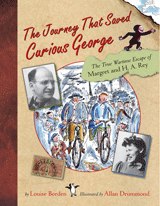
Review: The Journey That Saved Curious George:The True Wartime Escape of Margret and H.A. Rey by Louise W. Borden

Borden, Louise. (2005). The Journey That Saved Curious George: The True Wartime Escape of Margret and H.A. Rey. New York: Houghton Mifflin. 80 pages. ISBN 0616339248  .

Awards/Selection Lists: 
- ALA Notable Books
Author's Website: www.louiseborden.com
http://www.houghtonmifflinbooks.com
(follow the second link for great lesson plans to coincide with the book)

Brief Summary:  This title briefly explores the lives of Hans and Margaret Reyersbach, otherwise known as H.A. and Margaret Rey, the creators of such beloved children's titles as Katy No Pockets and Curious George. The story tells briefly of the German Jewish background of both families, how each studied art, and how each moved separately to Rio de Janiero, where they studied the natural world, worked on their craft and married. Shortly thereafter, a would-be 2 week honeymoon trip to Paris turns into 4 years of living, and a tumultuous journey to escape France together, under suspicion and great odds, as Hitler and the Nazi party invade Poland and France. Thanks to a manuscript about a curious little monkey, smuggled in a bike basket, their lives were saved not once, but twice, as they flee and fight for freedom.

Personal Reaction: I enjoyed this book. Both Borden and Drummond, the illustrator, tell the story in words and pictures as if H.A. and Margaret Rey were writing the story themselves for their readers. Included are photographs of the authors, journals, letters, early works, and period photographs, immersing the reader in the world and minds of the subjects. It has a light and loving tone, focusing on the artists and their love for each other, which makes learning about the danger they were in, and the difficulties of war less traumatic, and scary, while still offering enough information to encourage further exploration, if the reader so desires.
 
Front/Back Matter: Title page, copyright page, Introduction (Finding the Story), Part I: The Artists, Part II: Escape from Paris, Epilogue (After the Escape), Partial Bibliography of books by the Reys, Picture Credits.

Content Evaluation: While I enjoy the tone, and the partial bibliography of the Reys titles in the back of the book, and appreciate the photo credits, it would have been nice to have seen a reference page for the sources the author used. I know this is uncommon in children's non-fiction, but it is becoming more common in Young Adult non-fiction, of which this title is a part. Otherwise, the illustrations carry the story very well, and make the story just as endearing as the timeless classics the couples published after their escape.


Sunday, April 6, 2014

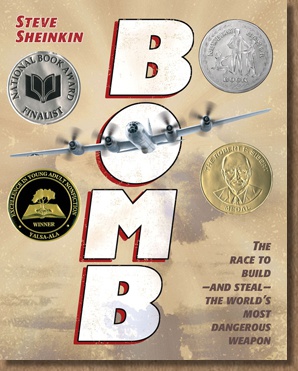
Review: Bomb: The Race to Build - and Steal- The World's Most Dangerous Weapon by Steve Sheinkin

Sheinkin, Steve. (2012). Bomb: The Race to Build - and Steal- The World's Most Dangerous Weapon. New York: Roaring Book Press. 266 pages. ISBN 9781596434875.

Awards/Selection Lists:
-Newbery Honor Book
-National Book Awards - Finalist
-Robert F. Sibert Award
-YALSA Award for Excellence in Nonfiction
-Bank Street Best Children's Book of the Year
 -Washington Post Best Books of the Year
  -VA Jefferson Cup Winner (Older Readers)

 -NBA Young People's Award Finalists 2000-2013


Author's Website: http://www.stevesheinkin.com
Brief Summary:  In 1941, when the Japanese attacked Pearl Harbor, the United States entered into the second world war, a war that threatened to engulf the entirety of Europe and Asia, and certainly affected every country on the globe. As the war got worse, and new types of brutal warfare emerged, a previous accidental discovery led to the greatest race, the race to end the war by creating the world's first atomic bomb. The only question was, who was going to get there first.
 
With allies fighting against each other, Norwegians being trained for secret spy missions to cripple the German's efforts, KGB blatantly recruiting in the United States, and the FBI trailing them all, a group of scientists were rounded up and brought to Los Alamos, New Mexico, where the American's effort to stop the war truly gained speed. But would it be enough and who were these men and women willing to risk everything, to create the impossible?


Personal Reaction: As with all Sheinkin's books, I couldn't stop turning the pages. Once again it felt like I was watching an action/spy thriller, rather than reading non-fiction. Being a huge history lover, particularly in regards to World War II, I have always been curious about the Manhattan Project and the nuclear physics that went into making the atom bomb but Sheinkin explained more about nuclear physics and fission by the time I got to page 82, than 12 years of science classes did! I was flabbergasted that not only was I reading this exciting true story of espionage, FBI agents, covert operatives, cutting edge science and the tools to stop the war, but I finally understood how these things worked and saw the faces of the people who made it happen, in the pages of this book. I found myself wondering what kind of security clearance Sheinkin had, and then realized, the man is just a superb research and an even better story teller.


Front/Back Matter: Preliminary title page, photo of an atomic bomb, title page, copyright page with dedication, table of contents, prologue,source notes, quotation notes, acknowledgements, photo credits, index.


Content Evaluation: (Same evaluation as previous title )One of the things I love about Steve Sheinkin's books is that he incorporates a lot of citations and first hand accounts, and more importantly, tells you where he got the information! So many other non-fiction writers completely skip over this part. Not only does he do this in text, but he provides a distinct quotations index by chapter and includes a detailed index, which allows for greater in-depth research and additional related reading on the subject. He even recommends books to start from. His enthusiasm is contagious and all the extra detail work shows, not only a great deal of research, but a great deal of thought and credibility. I can't wait to read more and I particularly liked the acknowledgement, which explains how the author developed the concept for the book.

Wednesday, January 11, 2012

W.A.Cs in Slacks

If any of my dear readers were born after 1960, and are not resplendent (HA HA) history buffs, like myself, you might be wondering, "What in the world is a W.A.C?! Is it a new fangled slang term all those young kids are using today?  Wait....I thought it was spelled "whack!! ", as in "That's whack, yo!" Well, all silliness aside, let me enlighten you.

Definition: W.A.C. stands for Women's Army Corps, or you may see it as W.A.A.C, the Women's Army Auxillary Corps, as it was often known in 1942.

http://www.history.army.mil/brochures/WAC/p25.gif


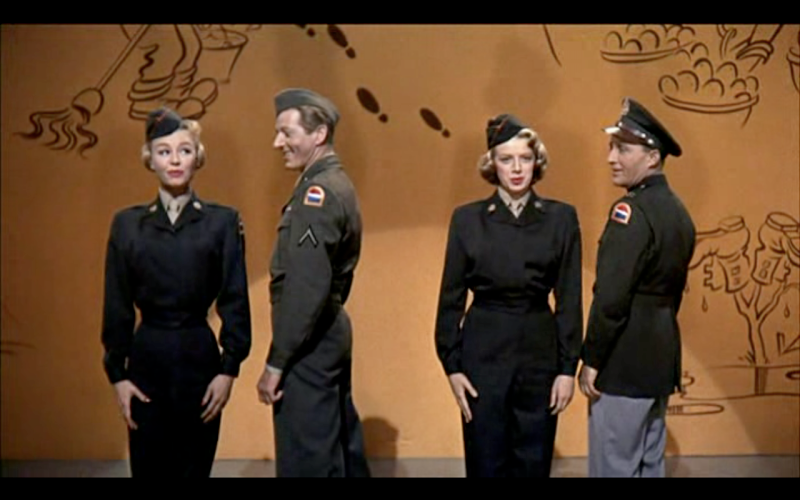
I'm not going to lie. I haven't always known what a W.A.C. was. In fact, my first exposure to the term itself came from watching Irving Berlin's White Christmas as a young child (Thanks Mom!).


In the first act of the final show for General Waverly, Bing Crosby, Danny Kaye, Rosemary Clooney and Vera Ellen performed a song called "Gee, I Wish I Was Back In the Army Now," in which my favorite stanza was:

"Gee, I wish I was back in the army
The army was the place to find romance
Soldiers and WAC’s the WAC’s who dressed in slacks
Dancing cheek to cheek and pants to pants"


This was my first exposure to the term "W.A.C." Did I understand what it meant? Absolutely not. Did it sound awesome, like perhaps there was some group of women out there randomly whacking people upside the head, or socking them in the arm when they got out line (my kind of ladies)? Heck yes! Did I find out what it was? You betcha!

It was pretty easy to infer that it had something to do with women wearing pants in the Army, and as a girly tomboy (yes I know that's a misnomer), I was all for it. As an young adult, I knew women had served in the military and worked in factories during WWII and been forced back behind the stove in many cases when the boys returned home from war. In fact, one of my favorite iconic images has always been the best marketing campaign ever (or some would argue propaganda) Rosie the Riveter, who encouraged women to step-up, become independent and confident, and take the demanding roles their fellas left behind in the wake of entering the war.


Really, reflecting on it now, this is probably the period when I became completely enamored with historical costuming and pop-culture from the 20's, 30's, 40's and 50's.(We'll cover me re-creating these period looks in a different post)

During the age of Nirvana and Soundgarden, in the midst of a budding Seattle music scene, which I enjoyed like any normal teenager (well ok, I was never a Nirvana fan....don't spread that around too much or the flannel mafia might come a-knocking), I can distinctly remember closing the blinds in my mother's family room during the summer days of high school, locked in with classic 1940's movies on the American Movie Classics channel.  (What can I say? I was also reading Shakespeare in the 6th grade, listening to The Doors, Gershwin, Steve Miller Band, Tommy Dorsey, Benny Goodman  and The Eagles at age 12. I never claimed I was normal!)

My favorite classic movie of the time? So Proudly We Hail (1943), starring Claudette Colbert, Paulette Goddard and Veronica Lake. (Wowzers) - The story of  Army nurses, serving overseas during WWII. Amazing movie. Check it out. (If you delve into the effect of Veronica Lake's hairstyle on factory workers prior to this movie, you'll also see the effect that Hollywood had on a public very much looking for glitz and glamour during an otherwise dismal and dark period of history, even back then. Sound a little familiar?)

Trailer:


This led to reading books on the subject, watching more movies from the time period, immersing myself even more in the music and eventually, many years later, long nights of internet searches and asking for first hand accounts from those I knew who lived it. So by now, you must be asking:


How did the Women's Army Corps come to be?:
While Congress refused to sign into law the original bill that offered women the chance serve as equals and to receive the same benefits as their male counterparts in the Army during WWII, including fighting overseas, "the final bill represented a compromise between the two sides. The Women's Army Auxiliary Corps (WAAC) was established to work with the Army, "for the purpose of making available to the national defense the knowledge, skill, and special training of the women of the nation." The Army would provide up to 150,000 "auxiliaries" with food, uniforms, living quarters, pay, and medical care. Women officers would not be allowed to command men" (Bellafaire, J., 2005).

It is interesting to note that in 1946 the Army ASKED Congress to allow the W.A.C. to become an official part of the Army. Congress took 2 years to do it, but added the W.A.C to its official Army roster in 1948. Interestingly enough, it was still in operation as a separate Army unit until 1978 when it was assimilated into the Army's traditional ranks. Also, anyone who has done a little research into sexual politics during the 1950's knows that, while social movements such as the Rockabilly music scene sought to continue to liberate and encourage independent women, the mainstream, socially driven post-war standard of women's behavior and gender roles turned into what could be considered an attempt to dumb down and un-emancipate those who had showed their independence during the war, when it was absolutely essential for the survival of the country and the war effort. Just a little food for thought there.

So what were W.A.C.s (members of the Women's Army Corps) allowed to do?
They were employed in communications, cartography (map making), running motor pools, as typists, pilots, switchboard operators, secretaries, cryptologists, radiographers, translators, and more, all in addition to the nurses already serving.


All of today's research started with a link that a Facebook page I subscribe to posted on their wall. It was from a blogpost entitled Women at War: WWII (click the hyperlink to go there).


It is amazing to read about them, but more poigniant to SEE women not only working in factories and jobs in allied countries, but also in ENEMY countries, whether they were snipers.......


 ...inspectors, guerillas, film-makers, made propaganda, or performed military and police training alongside men...in the 1940'S!

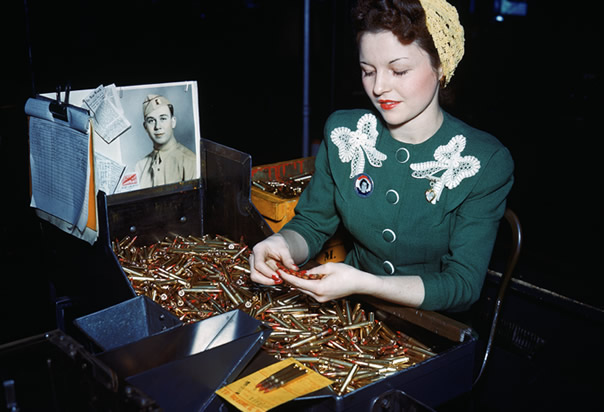
Teachers, librarians, homemakers, dressmakers, nurses, young adults, the elderly....they're all there, serving their countries and their moral convictions in a time where those resistant to change accused them of questionable character, morals and sexual deviancy, if indeed it could be called that today, for stepping into formerly "Boys Only" boots, though they were also told it was their patriotic duty to do so! And don't forget, they were called unpatriotic if they weren't pretty while they were doing "man's work" too! (I don't look this coiffed and polished NOW and I work at a desk job!!! These gals (above and below) are inspecting BULLETS for goodness sakes.)


There is also an incredible photo of part of the first contingent of African American W.A.C.s sent overseas, a HUGE step forward in civil rights. I must learn more!


And to all those who think women don't have the tenacity  (I.E. "GUTS") to be brave during combat, check out these stats.:

Of the 150,000 women serving as W.A.C.'s during WWII, "Ten women received the Soldier's Medal for heroic actions (not involving combat). One such incident occurred at Port Moresby, New Guinea, when an oil stove in the women's barracks caught fire and three WACs brought the fire under control by smothering it, sustaining severe burns in the process. Sixteen women received the Purple Heart, awarded during World War II to soldiers injured due to enemy action. The majority of the WACs received their injuries from exploding V-l bombs while stationed in London. The Bronze Star was awarded to 565 women for meritorious service overseas. A total of 657 WACs received medals and citations at the end of the war" (Bellafaire, 2005). This does not include those non-service personel, such as the Women's Airforce Service Pilots (or WASPs) below who waited to receive their Congressional gold medals, the highest available civilian honor, until 2009!

Now THAT is guts, fellas, in all her glory. ;)


For more info on this topic or the time period please see my Research Pathfinder on American Women in WWII located here:
https://sites.google.com/site/thewomenofworldwarii/


Resources: (too tired to pull out my APA reference style tonight...may update at a later date)
http://www.history.army.mil/brochures/WAC/WAC.HTM
http://en.wikipedia.org/wiki/So_Proudly_We_Hail!
http://thefrogseyebrows.blogspot.com/2009/12/cinema-tuesdays-white-christmas.html
http://archive.ccm.edu/rosie/index.htm
http://www.rosietheriveter.org/
http://womenslens.blogspot.com/2011/09/women-at-war-wwii.html
http://www.heresatissueclan.com/viewtopic.php?f=21&t=6997
http://beautyqueensheen.wordpress.com/tag/wwii/
http://www.city-data.com/forum/history/1186414-industrial-innovators-builders-wwii.html
http://cruelkev2.blogspot.com/2009/07/wwii-women-pilots-to-receive-medals.html

Pages

Search

Copyright Text