Friday, May 9, 2014

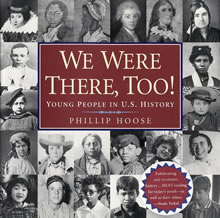
Review: We Were There, Too! : Young People in U.S. History by Phillip Hoose


Hoose, Phillip. (2001). We Were There, Too! : Young People in U.S. History. New York: Melanie Kroupa Books/Farrar Straus Giroux. 264 pages. ISBN 9780374382520

Awards/Selection Lists:
 - NBA Young People's Award Finalists 2000-2013
- Publishers Weekly Best Children’s Books of the Year
- American Library Association Best Books for Young Adults

Author's Website: http://philliphoose.com/


Brief Summary:  Sybil Ludington rode almost 4 times as far and long as Paul Revere for the same purpose. John Adams was a translator as a child. Claudette Colbert refused to give up her bus seat long before Rosa Parks. James Forten worked to abolish slavery not long after the Declaration of Independence was signed. Whether they were planting Indigo, holding back British forces, helping stitch the star spangled banner, organizing for fair labor, leading protests against the Vietnam War, fighting in WWII, revolutionizing the world's technology, starting environmental movements that would later shape the globe...these things were all done by children. They were all there, fighting, living, breathing, dying, putting their lives on the line, innovating, protecting, surviving time and again, overcoming incredible odds, and make a difference, making themselves heard, when no one thought to listen. Phillip Hoose gives them a voice and proves every young person can make a difference. Every person, young or old has a voice.

Personal Reaction: I believe this to be an ideal book for young people who are feeling lost in the world, just like so many of Phillip Hoose's titles. He is so good at giving children a voice, showing their extraordinary efforts and talents, showing that they can make a difference, they can be heard, they can be strong and persevere. They are just as astonishing, if not more so because of their young age, than their adult counterparts and make just as big of an impact. It makes the reader feel...important, to see people just like them overcoming, making a stand, doing what they thought was right, often overcoming not just the prejudice of age, but also color, gender, nationality, and idea. If you look, in every major even in history, they are there, just waiting to be heard, and Hoose did an amazing job of giving brief but thorough overviews of their accomplishments. In fact, he found so many, they filled up NINE parts in this book, and I'm sure there was plenty of room for more.

Front/Back Matter: Title page, copyright page with dedication, table of contents, introduction, acknowledgments, sources (by part...total of 9 parts in book), index.

Content Evaluation:  There was a lot of content to cover, so the way that Hoose has the book organized, chronologically and in sections, makes sense, and the index and table of contents makes navigation easier. He is relatively thorough with his list of sources, though slightly less so than in previous books, where there were more author notes and selected bibliographies. Still, there is plenty of citation of reputable factual material, and illustration or photos where available, though it would have been nice to have seen some color in the book, to catch the eye and keep the reader moving.

I would recommend this book be displayed, either in Young Adult, or in the Teen section, particularly, as a way to empower youth patrons and show them what can be done with direction and drive.

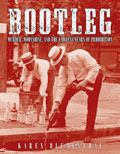
Review: Bootleg: Murder, Moonshine, and the Lawless Years of Prohibition by Karen Blumenthal

Blumenthal, Karen. (2011). Bootleg: Murder, Moonshine, and the Lawless Years of Prohibition . New York: Flashpoint Publishing. 154 pages. ISBN 9781596434493

Awards/Selection Lists:
- YALSA Excellence in Nonfiction Award, 2012 finalist
- American Library Association ALSC Children's Notable List 2002-  

  2013    
- Booklist Editor’s Choice Award, 2011
- Capitol Choices, 2011
- CCBC Choices, 2011
- Junior Library Guild selection
                                           - Kirkus Reviews Best Books for Teens 2011
                                           - School Library Journal Best Books of 2011
                                           - Texas TAYSHAS list

                                           - Richie's Picks


Author's Website: http://www.karenblumenthal.com/

Brief Summary:  With the help of such figures as Carrie Nation and Morris Sheppard, newly found temperance leagues fought a highly visible campaign against the ill effects of liquor on the sanctity of lawfulness and family in the United States. Utterly convinced that liquor was the cause of illegal activity, families falling apart, and all difficulties in the nation, these characters papered Washington, D.C., with pamphlets, introduced health primers in school with the dangers, exaggerated or not, of alcohol, broke up barrooms and saloons, and convinced citizens, particularly women, that it was their duty to put an end to drunkenness, and liquor consumption.When they had made enough noise to gain the imagination of the nation, John Volstead pushed hard to pass the 18th amendment, prohibiting the consumption or selling of liquor with an alcohol content of over .5 of 1%, unless kept in the home or for medicinal purposes. He was determined that this amendment would prevent drop outs and illegal activity, only to give rise to severe illness and the most notable and violent criminals ever known, like Al Capone, when people began to make and distribute their own alcohol, often paying officials bribes to continue their business unharmed. This phenomenon was known as bootlegging and it would take 2 more presidents before the amendment was repealed, and the dangerous process was all but halted, in an attempted to save America from the lawlessness that had been inspired by what people considered an idea of civility.

Personal Reaction: I thought this book had a lot of good information on the history of prohibition from start to finish, but it was a little lackluster and dry (no pun intended) in some areas, making it difficult to stay focused and interested. This could also be because of my propensity to become annoyed with characters, factual or not, that believe they know what is best for all people, and attempt to take away their freedoms over their own fears. I would love to say that the originators of the temperance movement had nothing but good intentions, but it is very clear from this book that simply wasn't the case, and in more than one instance, was an opportunity for power play, control, and the exhibition of more than one example of mental illness, and the inability to deal with personal tragedy.

Front/Back Matter: Photograph, title page, copyright page, table of contents, content, glossary, bibliography and source notes, source notes by chapter, acknowledgments, picture credits, index.

Content Evaluation: As previously stated, the tone was a bit lackluster, but there was a lot of good information included and the front and back matter is exceptionally thorough. I'd like to see more of the emotional impact and first hand accounts of people who lived through and were affected by the period and the amendment. I think that would go far to make the content a little more relatable, though it is easy to draw correlations between the fight against alcohol and current legislative issues with guns, tobacco and marijuana use.

Review: American Shaolin: Flying Kicks, Buddhist Monks, and the Legend of Iron Crotch: An Odyssey In the New China by Matthew Polly

Matthew, Polly. (2007). American Shaolin: Flying Kicks, Buddhist Monks, and the Legend of Iron Crotch: An Odyssey In the New China. New York: Gotham Books. 224 pages. ISBN 9781592402625

Awards/Selection Lists:
- A Compilation of Nonfiction titles on Best Books for Young Adults Top  Ten lists, 2001-2010
- Alex Award-Winning Nonfiction Titles, 1998-2013

Author's Website: http://mattpolly.com/

Brief Summary:  This is the story of author Matt Polly, and his rise from a skinny American kid, lost in the ways of the world, with only one desire, to go to China and learn KungFu from the Shaolin Monks themselves, to the defender of Shaolin tradition, tournament style. He learns discipline, he learns pain, he learns how to navigate the turbulent waters of China a mere stones throw in time from the period of Tiananmen Square, and the prejudice that Americans are expected to endure as foreigners in a contradictory land of corruption, honor, tradition and change. Because of his dedication and skill, Matt Polly became the first American ever inducted into the Shaolin Temple but it was not without sacrifice and an emotional inner journey.

Personal Reaction: Matt Polly writes of his 2 year journey in China with style and wit. He is undoubtedly funny and has maintained a sense of humor, even when recounting the most humiliating and difficult times of his journey in a country where walking on eggshells was necessary for daily living, as loyalties shifted as easily as a rolling tide. At times some of the technical jargon of KungFu can become distracting, but I found myself still enjoying the story, as if a favorite friend was telling me a story of their great adventure. Even though it wasn't one of my favorite books, it is one of my favorite stories and his reactions then, and the flavor of his address is charismatic and familiar. I would definitely recommend this book to reluctant readers who may be feeling a little lost in the world, but who also have some interest in martial arts. The chapter on Iron Crotch Kungfu alone had me in stitches. His reactions and recollections were priceless, and very easy to relate to. I love this man's writing style.

Front/Back Matter: Title page, dedication, table of contents, a note on spelling and pronunciation, secondary title page, Chinese proverbs, prologue, author's note, acknowledgments.
Content Evaluation: I would have liked to have seen a little more about Chinese culture, as references or appendixes in this book, but a beginning primer for the more important Chinese names, and Polly's explanation of his education in Chinese culture is enough to get you through. The tone is funny and relatable, at times serious, but still maintaining and element of play. It is laid out logically and does not include an index or source notes, typically because this is a first hand telling, an autobiography, rather than a research project.

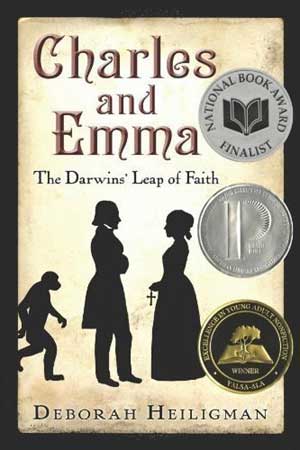
Review: Charles and Emma: The Darwins' Leap of Faith by Deborah Heiligman

Heiligman, Deborah. (2009). Charles and Emma: The Darwins' Leap of Faith. New York: Henry Holt and Company. 268 pages. ISBN 9780805087215

Awards/Selection Lists:
- Printz Honor 2010
- National Book Award finalist 2010
- L.A. Times Book Prize Young Adult Literature Finalist
- YALSA Excellence in Nonfiction 2010
- CCBC Choices List 2010
- Oprah's Book Club 2010 Kids' Reading List: 12 and Up
- New York Times Editor's Choice

Brief Summary:  Through and through, this is the love story of Charles and Emma Darwin, literally kissing cousins who married and had a typical Victorian family, typical except that Charles was shaking up the world by redefining the world's view of creation, nature and the origin of man. Being mildly spiritual, where his wife was incredibly devout, after losing her sister, it became a gulf between then, that they had to span by a leap of faith. Together they endured tragedy, controversy, devastation, ill health, strife, and Emma's growing concern that she wouldn't meet her beloved husband in the after-life, yet they still came out together, still in love and still devoted, with a good tale to tell.

Personal Reaction: I had a difficult time finishing this book. In fact I had to pick it up and put it down twice. While the story of Charles and Emma Darwin is really interesting, I was constantly distracted by the constant interference of Christianity in their story. I understand the context of this element. In England, during the time period, it was extremely common for Victorian women to be incredibly devout, and for religion to rule the roost, and also I understand the strife and heartache it caused Emma. However, at some point during the story, it, and the difference between their two faiths, started to sound more like a nagging presence rather than an obstacle to be overcome and I found myself annoyed. I wanted to learn more about their dynamic, the trials and tribulations they went through, his work, his family, and while I understand that religion and the moral views of the time period were intertwined, I wish they hadn't upstaged his incredible journey.
 
Front/Back Matter: Title Page, copyright page with dedication, table of contents, foreword, content, acknowledgements, family trees, source notes, selected bibliography, index.
 
Content Evaluation: The tone could be a little dry, though certainly you can tell that the author was interested in her subject. While a selected bibliography is less superior than a full one, the source notes, which take up more than 14 pages, are excellent, and arranged by page number and occurrence. I would have liked to have seen more illustrations and photos of the Darwins and Charles' work. I think it would have helped carry the story and immersed the reader in the world.


Wednesday, May 7, 2014

Review: Amelia Lost: The Life and Disappearance of Amelia Earhart by Candace Fleming

Fleming, Candace. (2008). Amelia Lost: The Life and Disappearance of Amelia Earhart. New York: Schwartz & Wade. 128 pages. ISBN 9780375841989

Awards/Selection Lists:
- Nonfiction titles from ALSC Notable Books lists 2002-2013
- Bulletin of the Center for Children's Books, starred review
- Golden Kite Award for Nonfiction, 2012
- Horn Book, starred review
- Kirkus Reviews, starred review
- School Library Journal, starred review

- Richie's Picks


Author's Website: http://www.candacefleming.com

Brief Summary:  Most people know of the amazing story of Amelia Earhart, the first woman to cross the Atlantic, lost of her world hopping trip across the equator, with her troubled but brilliant navigator, Fred Noonan. There have been numerous books over the years speculating over the why and the how but this is the first book I have read that actually chronicles the life, from beginning to end, and nature of Amelia Earhart. A tomboy, a student, a nurse, a social worker, a sister, a daughter, a firecracker, a pilot, a wife.....she was many things and she led a colorful life and broke through social barriers with a finesse that continues to inspire generations of women. She wanted to be free, she wanted to be happy, and no one was going to get in her way.

Personal Reaction: I really, really enjoyed this book. Earhart has been a favorite subject for me since I was child. I grasped onto characters who refused to be pushed around and hide who they were, who bucked against the system to pave the way for future children to find their true paths, hopefully with less discrimination and hardship. This book on Amelia's life is the most complete, compassionate, personal I have read. There are so many photos and accounts, personal details that many others leave behind that really let you connect with her character, her choices and her driving force. I particularly like the interspersed "special sections" which recount first hand accounts of people, many being children, who believe they heard some of Amelia's final words or discovered her location, though no one would listen.

Though her death was incredibly sad, she left a legacy, and through the story that Candace Fleming weaves of her life, we can really understand what a brave and formidable woman she was.
 
Front/Back Matter: Title page, copyright page, acknowledgments, contents, foreword (Navigating History), content, bibliography, "Finding Amelia on the web" sources notes by chapter, picture credits, index.
 
Content Evaluation: This book is very well organized, with a lot of source notes (which I love, it always makes the book easier to believe in), and fantastic resources. There are hundreds of photographs included, but they are organized in a way that doesn't detract from the story, but rather helps carry it and form attachment. The tone is strong, factual, but compassionate and it is a great, and fast read.


Review: Ben Franklin's Alamanc: Being a True Account of the Good Gentleman's Life by Candace Fleming

Fleming, Candace. (2003).Ben Franklin's Alamanc: Being a True Account of the Good Gentleman's Life. New York: Atheneum Books for Young Readers. 119 pages. ISBN 0689835493

Awards/Selection Lists:
- Richie's Picks
- ALA Children's Notable Book
- ALA Best Book for Young Adults
- Association of Booksellers for Children Fall Favorite 2003
- Book Links Best Book 2003
- Booklist Top ten Biography for Youth, 2003
- CCBC Choices 2004
- Children's Literature Choice 2004
- Great Lakes' Great Books Nominee 2005
- James Madison Award Honor Book
- Jefferson Cup Honor Book (Virginia Library Association) 2004
- Junior Library Guild Selection
- Maine Student Book Award Nominee 2004-2005
- NCSS-CBC Notable Social StudiesTrade Book 2004
- New York Public Library Best Book for Reading and Sharing, 2003
- New York Public Library Best Book for the Teen Age, 2004
- Parents Choice Gold Award Winner
- Publishers Weekly Best Book of 2003
- Riverbank Review Children's Book of Distinction 2004
- School Library Journal Best Book of 2003
- Washington D.C. Capitol Choices Book 2003


Author's Website: http://www.candacefleming.com/

Brief Summary:One of the founding fathers of the nation, Benjamin Franklin is well known, and his accomplishments well documented. Laid out in chronological order, Fleming leaves no stone unturned to reveal Franklin's tenacity, ingenuity, curiosity and his utmost desire to do right by his country, his children, and those he served, by improving, doing, pushing the envelope and not being afraid to offend those in power by being honest, just and proud.

Along with his innovations in his electrical experiments, instituting state schools, libraries, fire brigades, becoming first Postmaster General, being a member of the Continental Congress, helping write the Declaration of Independence, he was a skilled diplomat, a lover, a writer, a man who believed less in organized religion and more in the spirituality of doing the right thing and being chased by the consequences throughout subsequent life-times. He was a complex and interesting character whose humanitarian efforts are often outweighed by the extravagances of his later diplomatic years in France, in part due to the outrage of John Adams wife. Nevertheless, he remains, one of America's most spectacular historical figures, with much more to tell.
 
Personal Reaction: I won't lie, I had a hard time getting through this book. I am very interested in the content, and there is SO much information that I had not previously read on Franklin. You really get a sense of his desire to help his fellow man, of his humility, and his curiosity through Fleming, but it is a bit overwhelming being crammed in small print into 119 pages. Also, while there are many illustrations, everything is in black and white and made to look like an old fashioned newspaper page, which I understand the desire for. However, it makes it difficult to stay focused on the content as there is no color to relieve the eye and offer excitement and a way to really connect with Ben's character.
Front/Back Matter:Title page, copyright page, table of contents, foreword, chronology, content, bibliography, picture sources, additional resources (one page for books, another for websites), index.

Content Evaluation: Very well informed and well documented, the content is extremely fact heavy. I would have liked to have seen a more personal narration, some way to connect and empathize with Ben, rather than just being told about his life. The use of color and a different format might lead to a better review of this book. I think I will attempt to re-read it for leisure, to re-assess if my perceived time constraint caused me to be less entertained by this book. However, its relative dryness is one of the things I dread most. Hundreds of tiny stories inserted into different frames on the page also make it difficult to keep the chronology straight. Still, as I said, I'm willing to give it a second chance.


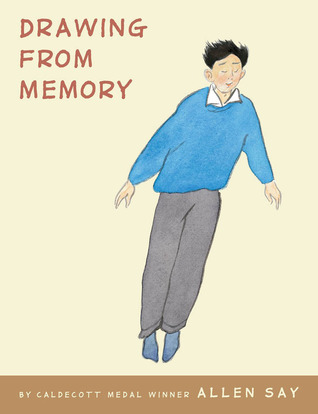
Review: Drawing From Memory by Allen Say

Say, Allen. (2011). Drawing From Memory. New York: Scholastic Press. 72 pages. ISBN 9780545176866

Awards/Selection Lists:
- Nonfiction titles from ALSC Notable Books lists 2002-2013
- Richie's Picks
- Siebert Honor


Author's Website:http://www.houghtonmifflinbooks.com/authors/allensay/

Brief Summary: Allen Say is an award winning, Japanese born illustrator and writer who led a very interesting and independent life, determined to become a cartoonist, seeking out his mentor, his sensei, on his own at the tender age of 13, while living on his own and attending school. Later, he moves to America with his estranged father, to live his dream, but the relationship with his sensei, and what he has learned about drawing as seeing and painting as writing, stays with him forever, as this memoir to his great teacher proves.

Personal Reaction: I adored this book. I love Japanese culture and this book reads an awful lot like a lot of the literature I have read from that area. It may seem a little choppy, and some of the content is told with pictures instead of language, which could be why this is listed in our OPAC as a graphic novel, regardless of the fact that it is covered in photos and cartoons, but I think that it fits very well with the storyline and the geography. Say led a very interesting life, and it is amazing to see the amount of independence post war Japan allowed him, and never thought twice about. Even with his father, his grandmother, and some teachers telling him he would never amount to anything as an artist, he pursued his passion, encouraged by his sensei, 2 teachers and a few friends to become one of the most celebrated talents.

Personally, I think what I love most about this book is that I always wanted to be an artist, but was always told that it wasn't lucrative enough to be an occupation, and then the time I could have used to train and perfect a craft was wasted, as it became a sometime hobby, and one that I often hid from others. I really take Say's story to heart because he pursued his passion to the very end and lived his dream. Like those people he saw in Tokyo that lived and died in offices, I lived that way, and I would prefer to live like Say, following his example. It makes you wonder, is it ever really too late?
Front/Back Matter: Title Page, main page, copyright page, dedication, content, author's note.

Content Evaluation: As stated above, the tone is a little choppy, but very appropriate for a Japanese styled book and I think it carries the story, very well. The photos and illustrations are plentiful, the language easy to absorb and the author's note helps tie it all together, really identifying the purpose of this book, to honor his sensei.


Pages

Search

Copyright Text