Friday, March 21, 2014

Review: Vincent Van Gogh: Portrait of an Artist by Jan Greenberg and Sandra Jordan

Front Cover
Greenberg, Jan, and Jordan, Sandra. (2001). Vincent Van Gogh: Portrait of an Artist. New York: Delacorte Press. 132 pages. ISBN 9780385328067.

Awards/Selection Lists:
- Robert F. Sibert Honor book
- ALA Notable Book
- ALA Best Book for Young Adults
- Common Core State Standards Text Exemplar

Author's Website:
 
Brief Summary:  One of the most famous painters in history, this chronological account of the life and work of Vincent van Gogh begins with the birth of Vincent to Dutch Reverend and his wife. The first live child, but second of his name, to arrive in the household, Vincent's life never seems to travel in a straight line. Whether he decided to teach, to preach, or to draw and paint, he did so with relish few others could match, and with a fragility, humanity, and eccentricity unsurpassed by modern artists. Contemporaries of Gaugin, Toulouse-Lautrec, Manet, Monet and the Impressionists, Vincent's relationship to art, his family, and the world around him would lead to emotional masterpieces the world has not seen since, nor are they likely to.

Personal Reaction: Vincent van Gogh holds a special place in my heart, much like Einstein, da Vinci and P.T. Barnum. Often misunderstood, but highly emotional and sometimes intentionally reclusive, these artists and larger than life celebrities dared to live life outside the lines, creating a brighter, more vivid, compassionate and imaginative world than they came from. Van Gogh was often portrayed as troubled, mentally ill, and unstable. However, while not ignoring these facts, this biography places him squarely in the world of the attainable artist, the sensitive fellow searching for his place, his talent and his legacy for the world. Instead of being simply insane, the author shows how it is possible that, due to emotional stress (something that can be debilitating in highly sensitive individuals), poor diet, and partaking of the ever popular toxic absinthe, Vincent may have had epilepsy, contributing to some of his more strange behaviors. I would have liked to have seen a little more information on the side effects of prolonged absinthe usage, as it has been known to cause hallucinations, of which it was said Vincent suffered, but overall, the authors presented Van Gogh as a true person, rather than a commodity, and I think that is difficult to portray in non-fiction, while attempting to maintain facts.
 
I appreciated that the authors often fit his more famous works into the timeline of events of his life, to help the reader understand the factors that influenced his work and also the connection to his family, particularly his father, mother, and brother Theo, who financed him, both as a brother and an art dealer, for the majority of his life. Overall, I was amazed at the depth of knowledge explored on Vincent in this short 132 page work. A definite good read, though a little dry at points. It sill makes me wish I could paint the way I feel, like Vincent strove for so long to do.
 
Front/Back Matter: Front cover,  Title page, Copyright Page, Dedication, Contents, Map, Prologue, Chapters from birth through death, Postscript, Biographical Time Line, Museum Locations, Glossary of Artists and Terms, Notes, Index, About the Authors.

Content Evaluation: One problem I always have with children's non-fiction is the lack of accountability and citation of sources. The authors speak a lot to Vincent's emotional states, and those of his family and friends. Certainly some of it can be assumed due to the tone of letters and correspondence, but with no first hand accounts, how can this be positively assumed? However, the time line, postscript denoting Vincent's sister-in-law preserving his works and letters for display, the glossary and artist listing, as well as museum location lends an air of credence given the amount of research necessary to acquire this information. The Notes are where the authors gives their sources, chapter by chapter, and lends more authority to the research.

Thursday, March 20, 2014

Review: Persepolis: A Story of Childhood by Marjane Satrapi

Front Cover
Satrapi, Marjane. (2003). Persepolis: A Story of Childhood. New York: Pantheon Books. 160 pages. ISBN 9780375714573.
 
Awards/Selection Lists:
 - ALA Alex Award
 - YALSA Best Books for Young Adults
 - Booklist Editor's Choice for Young Adults
 - New York Public Library Books for the Teen Age
 - School Library Journal Adult Books for Young Adults
 
Author's Website (Agent): http://barclayagency.com/satrapi.html
Brief Summary: A memoir of the author's childhood, beginning at 10 years old, in the year 1979, the beginning of the Islamic Revolution in her home country of Iran and spanning the Shah's removal, and the war with Iraq, this black and white graphic novel presents a very approachable account of a very troubled and gruesome time. Luckily, for the outspoken and independent Satrapi, her parents were progressive and encouraged her free thinking, going so far as to send to her Vienna at the age of 14 to help her escape the oppression in her home country, in order to give her a better life. This novel explores her inner thoughts, her outer influences, dangers and traumas, as well as the effect and reactions of her loved ones.
 
Personal Reaction: I was really surprised in that I loved this book. I had been drawn to it in the past because it is a graphic novel, but passed it up upon learning it was a non-fiction account of a childhood in turbulent and violent Iran during the 1980's. I can recall hearing some terrible things about this time and this country, and the atrocities against girls and women during my childhood. Satrapi does tell of these atrocities, to inform the reader and be true to her own story, but she does it from the perspective of a 10-14 year old girl, and somehow, while it can be hard to understand, it is not presented in a way that would turn off or traumatize the reader. It's done in an honest but understanding manner and I think that, through the telling of her own thoughts and mental state, her attempts at pushing the boundaries, her parents' difficulties and in their successes and support, it becomes encouraging and an eye opening look at how one girl can make a difference. This girl, the author, now a grown woman, is making her difference by telling her story, and hopefully, opening the world's eyes to what goes on behind closed borders and showing that with perseverance and love, life goes on.

Front/Back Matter: Title page, Copyright Page, Introduction, Chronological author account, Credits.
 
Content Evaluation: Overall, I would say this is a superbly written book. It is emotional without being assumptive, and truth without necessarily pointing a finger. She never comes out and condemns one ideology or the other. She simply shows the consequences, how people felt, their reactions, and (now) well documented crimes that are committed when powerful people think no one is watching. I kept waiting for blame to be issued, but throughout the entire novel, while I understood where the author's parents' loyalties lay, she never once came out and said one person was wrong over the other, and that is beyond commendable. She let their actions speak louder than blame ever could.

Friday, March 14, 2014

Review: Perfect, Once Removed: When Baseball Was All The World To Me by Phillip Hooose

Hoose, Phillip. (2006). Perfect, Once Removed: When Baseball Was All The World To Me. New York: Walker and Company. 163 pages. ISBN 9780802715371.

Awards/Selection Lists:
 - Author Study List

Author's Website: http://philliphoose.com/
 
Brief Summary: As a child in the mid 1950's, the author found himself as the new kid in Speedway, Indiana, sticking out like a sore thumb but desperately wanting his peer's acceptance. The ticket to school yard success? Baseball. He struggles to learn the game with any proficiency and at the same time ,comes to realize how baseball has shaped his life and his connections to friends, family and teachers, especially after he finds out that he has a cousin in the major leagues.  

Personal Reaction: Anyone who has ever been the new kid in town and desperately wanted to fit in can relate to this book and Phillip Hoose's reactions as an 8 year child, feeling awkward and aone. Also, anyone who enjoys the golden-age of baseball, the history behind it and the national fervor, the way it brought people together, will also relate to this book. It's a great melding of two topics, seamlessly done.

As a child, I became interested in baseball as a way to connect to my father after my parents split, and my sister left for college. My favorite team, the New York Yankees, is coincidentally the same team that Hoose's cousin, the legendary pitcher, Don Larsen, played for. My love for the Yankees, in a sea of Seattle Mariner's fans (which is tantamount to social suicide in some circles) was due to the tradition of the Yankees, their connection to history, to legendary figures, to the golden-age of baseball, where a sport could unite an entire nation in joy, becoming the "national past-time." I loved to imagine myself in the 1940's or 50's in the grandstands of the classic stadiums, eating peanuts and cheering for my favorite players, where they seemed like gods and men at the same time, instead of the unreachable stars of the game today. That's where I found myself again, reading Hoose's memoir. Not only could I relate to this poor kid trying to find someway of fitting in with other children  and feeling like an outsider  (I moved around a lot and went to 6 elementary schools), but I got caught up in his excitement and the connection, passion and pride that baseball and his quest brought as time progressed, in an age of innocence.

Rest assured, while there are many references to baseball and history, it's still an interesting read, but I will admit that in the last chapters, the play by play description of the fateful 1956 World Series no-hitter rather lost my attention, much the way Charles Dickens' descriptions can. However, Hoose's excitement was clearly palpable and the family connection and pride that he saw built and sustained over decades in his family, and what he inspired himself, clearly show that some passions built early never die.

Overall, I very much enjoyed this book, and reading about another child's ability to find baseball as a type of personal salvation and family camaraderie, and the continued meaning it has as an adult.
 
Front and Back Matter: Copyright, Title Page, Book Titles, Dedication, Note to Reader, Chronological Memoir of Author's introduction and love affair with baseball, and his connection to legendary NY Yankees pitcher Don Larsen, Epilogue, Acknowledgments, About the Author.

Content Evaluation: Very well written and personable, Hoose has a good flow and excellent use of the written word. My only complaint would be that he clearly states in the Note to Reader, that "much of the dialogue....is re-created because I am not able to remember the exact words of family, friends and acquaintances of fifty years ago. It is however entirely accurate as to what was said and how it was said." Now I completely understand not being able to recall conversations from 50 years ago word for word. I can barely do so with conversations 5 days ago. However, this note bothers me, I think because he states that it is still entirely accurate as to how and what was said. While I'm sure the feeling is the same, how does he know it's accurate if he can't recall the exact wording? Wouldn't it have been better to have just mentioned that perhaps conversations were para-phrased, thereby lessening the questionability of the factual nature of this non-fiction? Then again, it is an autobiography of sorts, and much more questionable ones have been fashioned. While his phrasing bothers me in this "Note", I have no doubt that the intent of the conversations is very much, as it was, 50 years ago.

Saturday, March 1, 2014

Review: Steve Jobs: The Man Who Thought Different by Karen Blumenthal

12969593

Blumenthal, Karen. (2012). Steve Jobs: The Man Who Thought Different. New York: Feiwel & Friends. 320 pages. ISBN 9781250015570.
 
Awards/Selection Lists:
YALSA Excellence in Nonfiction Award, 2013 finalist
American Library Association Children's Notable List
Booklist Editor's Choice list, 2012
Junior Library Guild Selection
Kentucky Bluegrass Award Middle School list
Librarian's Choices, 2012
Texas Lone Star List
 
Brief Summary: Steve Jobs, the founder and savior of Apple Inc., and Pixar, was a controversial figure, volatile but brilliant, not always honest, but a visionary. He helped shape the world in which we live in through this vision, through his faults and his strengths, through his life story, and many people never even knew it. This book follows Jobs' life, from birth and adoption, through death, controversy, bankruptcy, failure, terminations, growth and successes, giving the details of his life transparently, but without vilification.
 
Personal Reaction: I have mixed feelings about this book. While it was written well, and easy to read, it's always hard to hear the negative aspects of a person whom you have heard some great wisdom come from. But then again, that's exactly why I chose this book: to be able to better understand what Steve Jobs was about, what his personal philosophy and work ethic was, and to make my own opinions based on the evidence presented. The truth of the matter is Steve Jobs wasn't always nice. He wasn't always likeable, or a good father and husband. Sometimes he was a terrible friend and all of these things were harder for me to reconcile than any issue with him being bad at business, in certain aspects. However, it really taught me that people who make a profound difference on the world don't have to be perfect. They can make mistakes, and doozies at that, and still be an example, can still help people, can still turn a corner and decided to be better to those around them, and while they may change in the details, essentially, they are the same person at heart. The bottom line is, I learned from him, as well as his mistakes. I learned that my tenacity can be rewarded and I can be having a positive effect on the world right now, and not even know it, but it's still a worthwhile goal. I don't have to be perfect. I can (and do) make mistakes but picking myself up WILL get me somewhere, even if I don't see it now. Most importantly, I have to agree with him, to live your life for yourself, not up to other people's expectations and to do what you love, have faith that in the end, somewhere, the dots will connect.
 
Front and Back Matter:  Title page, copyright, table of contents, introduction, chronological biography, illustrated timeline, author chapter notes (includes which resources were used in each chapter, in lieu of a formal bibliography), glossary, index.
 
Content Evaluation: At first I thought the author might be making conjectures as to Jobs' emotion state, only to find she would follow it up with a direct quote from Job's himself. That gave me a good sense that she had definitely done her homework. I was impressed that she did not sugar coat the less than favorable details of Jobs' personality and dealings, but she struck a harmonious balance, by not vilifying him, even at times, I think, putting slightly more emphasis on his positive attributes and dealings, though always keeping in mind the dirty. Overall, it was a well balanced biography and I think interesting for anyone who is still struggling to find their way, and wonders if they will ever get there, especially those that are the exploring sort, while trying to find the road less travelled, but with greater reward.

Thursday, February 27, 2014

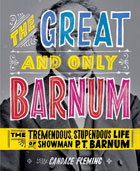
Review: The Great and Only Barnum: The Tremendous, Stupendous Life of Showman P.T. Barnum by Candace Fleming

Fleming, Candace. (2009). The Great and Only Barnum: The Tremendous, Stupendous Life of Showman P.T. Barnum. New York: Schwartz & Wade Books. 151 pages. ISBN 9780375945977

Awards/Selection Lists:
-ALA Best Books for Young Adults 2010
-ALSC Notable Book 2010
-Booklist Top Ten Biographies for Youth 2010
-Kirkus Reviews Best Young Adult Book 2009
-New York Public Library 100 Books For Reading and Sharing Title
-Publishers Weekly Best Book 2009
-VOYA "Perfect Ten"
-YALSA Award for Excellence in Nonfiction for Young Adults 2010 (nominee)
Brief Summary: P.T. Barnum was arguably the world's greatest showman. No small life could contain him. Amongst his better known accomplishments are the Barnum & Bailey Circus and the P.T. Barnum American Museum, which burned down, not once, but twice, in New York City. But did you know he was also a politician, a humanitarian, a businessman, a church goer, a recovered alcoholic, a husband, an advocate for animal rights, an independent consult for biologists and budding zookeepers, and a father of 4 daughters, full of life and humor until the very end of his 81 years?
Personal Reaction: I LOVED this book, flat out loved it. I relished every page, meticulously examined every photograph, every etching, reread the account of this enigmatic man's life, time and again. It was the perfect length, an upbeat, easing flowing tone, and the illustrations really gave a feeling for life during the subject's time. I believe it to be excellently written!
 
I have a passion for history. I've always had this passion and traditional American forms of entertainment, particularly those appealing and available to the young and old, the poor and the wealthy, have always fascinated me because of their attachment to history and their ability to bring people, from all walks of life, together. You can practically feel decades of smiling faces, curiosity and tradition, palpable in the air at these events. You can imagine yourself in a bygone era, enjoying the simple pleasures, marveling and learning new things, and building memories with loved ones. The one event that immediately might come to mind is good, old-fashioned, American baseball, which is of course, one of my very favorites. The second that comes to mind? The American circus, and no one did the American circus better than the larger than life figure that was P.T. Barnum.
 
Content: Before I read this book, I had heard some things about P.T. Barnum, some good, but many vilifying, without any real documentation to back it up. This always bothered me, as I'm a staunch believer in making my own mind up about people, for where some see little worth, I may see a glittering jewel. I get the feeling that Candace Fleming may have felt the same when she set out to write this book. While she consulted many of Barnum's own documents on his life and business dealings, she also consulted biographies and first hand accounts, stories, legends, and even writings on the ideology of people and conditions of living during his time. I believe this to have created a full, spherical account of his life from all directions, avoiding creating what I term as a "cabochon" effect, that is, the appearing fullness on the top, with a flat and deceptive back. Most people hear of atrocities and animal abuse at circuses, of Barnum as a deceiver and only interested in money. The truth, as Fleming sees it, is much more interesting.
 
On the charge of animal abuses and atrocities, Fleming points out that many of the animals Barnum acquired were exotic, never before cared for in the Western world, and most people in his day simply did not consider collecting them for exhibition to be wrong. In his defense, as his collection expanded and his years went on, he became an invaluable asset to Natural History, Biology and newly established Zoology. He was known as an animal expert, because he had decades of experience feeding, caring for and observing these animals and their behaviors. As he grew older, he began to show empathy for them, building them larger habitats and sobbing over their fates after the last devastating museum fire. When they died, regardless of the cause, he often donated their bodies, skeletons or their taxidermied epididymis' to universities for study, such as Harvard. He kept log books and had specialized railroad cars developed for them, and spoke out in defense of them in public venues and during his tenure as mayor and councilman. When a self-proclaimed animal advocate spoke out against his treatment of his animals, or the tricks they performed, Barnum was completely transparent in his dealings and showed the advocate, publicly, how the animals were in no harm, so much so that, while they butted heads over many years, he grew to have a healthy respect for the advocate's work.
 
On being a deceiver and only interested in money, Fleming shows this simply was not true. Barnum's opinion was that everyone liked a good "humbug", that is, a practical joke, as long as they know they are in on it. People like to be entertained, to hear a good story, to make up their own minds as to what is truth and what is not. He did write letters to newspapers claiming to be other people, to help potentiate the stories of his attraction, but this was in an era where fantastic fiction was more readily reported as fact than actual researched and documented facts. Facts didn't sell newspapers and journalists were not held accountable. When one of these humbugs were discovered, much of the public was delighted at the joke, as they were never malicious. Was it strictly for monetary purposes? Was he trying to make people look a fool to increase his profits? Not exactly.
 
Barnum believed people wanted and needed to be entertained. They wanted to believe in the impossible, in the grand, to escape the mundane qualities of everyday life and dare to dream, just like he did. Did he have an interest in profit making, being a businessman? Absolutely! But no one seems to mention that there is no record of a malicious attempt at making these profits, that he compensated his performers EXTREMELY well, paying for food and board, medical expenses, costuming and generous wages at a time when those who were "different" could be shunned and left to die in the street. Barnum believed that these people were not freaks but wonders, people to be marveled at, respected and exalted. He got them together with the public, and got them talking, lecturing, occupying the same space and he helped them earn a tidy living. He wasn't just about miniature people, giants, dog boys and Siamese twins. He also highlighted and promoted inventions and entertainers of all types to great success, most notably, the singer, Jenny Lind. He had a talent for promotion, for entertaining, for making people happy.
 
Was he perfect? Absolutely not. But he showed a strength of character in the way he dealt with people, helped his community, was passionate about making people happy and owning up to, and correcting his mistakes that was admirable and above all, he was a fighter and a dreamer. Life would knock him down, from the time he was a young boy, and he would get back up and fight harder, make a way for himself and try to make people happy. In doing so, he made himself happy. He had strong relationships and tender feelings, big mistakes, but bigger comebacks, remarkable talents, education and gumption, and a huge concern for his fellow man, but never before have I seen it all laid out, accessible and entertaining as Candace Fleming puts forth in this book.
 
Content Evaluation: It is very obvious that the author exhaustively researched this book. There are so many, what I consider to be, "little known" facts about P.T. Barnum (did you know his name was actually Phineas Taylor, and that he was named after a prank loving uncle, or that he helped establish a library and never did say that famously attributed line of "There is a sucker born every minute"?) that make it plainly obvious that Fleming was determined to tell as much about this man's life as possible. It's very easy to read, with explanations of circus terms, ideologies of the time, and a fantastic Source Note section, laid out by chapter, in addition to an annotated bibliography. I don't recall the author at any time making conjectures about what happened or how someone felt. She is very sure to mention supporting evidence to back up her claims. While sometimes I thought that it might have been an overly positive evaluation of P.T. Barnum, by the end of the book I realized that the negatives were also brought to light, such as his drinking early in his career, being an absentee father, his less than kind verbal attentions to his wife (while he was drinking), his recovery, his bad business dealings, his bankruptcy and more, making the story much more balanced, and again, a much rounder, fuller account.

Friday, February 14, 2014

Review: Gage: A Gruesome but True Story About Brain Science by John Fleischman

 
Fleischman, John. (2002). Phineas Gage: A gruesome but true story about brain science. Boston: Houghton Mifflin. 86 pages. ISBN 9780618494781

Awards/Selection Lists: Non-fiction titles from ALSC Notable Books lists 2002-2013, Richie's Picks

Author's Website: http://www.scholastic.com/teachers/contributor/john-Fleischman

Brief Summary: Phineas Gage was a railroad foreman in the year 1848, when an accident with blasting caused a 13.5 foot iron rod to enter his check and exit cleanly through his skull. Amazingly he made a full recovery, but at what cost?

Personal Reaction: I have always found the story of Phineas Gage to be unsettling, mostly because of the graphic nature of the injury. However, the effects of the accident on the brain are fascinating, and something I have studied for some time with my psychology classes. Fleischman does a good job of laying down the general story of Phineas Gage, with interesting personal details and no elaborated personal opinion, however, I think he could have gone farther with his analysis, perhaps even looking into whether mental illness was a factor in his family tree, or if there was the possibility of genetic illnesses  that could have led to Gage's deterioration (though he does state no family history of seizure...but from where does this information come from?), instead of guessing that the jostling of his brain in his skull, while driving a stage coach, may have lead to eventual seizure disorder and death.

Also the medical information is extremely distracting. It's interjected in the middle of the story and, while I'm sure it is meant to be informative and keep the reader interested, by its placement, it tends to disconnect the engaged mind, with a lot of advanced medical jargon that I do not see many children keeping up with, not for lack of trying. The illustrations and photographs, however, really helped move the information along.

Regardless, the book is written in a good tone, the story interesting, and even I learned a new fact or two, but there are holes in the research and I believe it almost feels at the end as if the author had given up, and chose to simply guess at the cause of death.

Content: With limited scientific knowledge, in an era where knowledge of the effects of bacteria on the human body, and the development of antibiotics, cellular biology, microscopes and proper surgical sanitization techniques was in its infancy, Phineas Gage, a hard working, well respected railroad man, of 26 years, is involved in an accident which sends a metal tamping rod through his skull, damaging his brain. Miraculously, after the incident he can still walk and talk, relaying his experiences to those who would listen, and eventually, even with rudimentary and antiquated medical practices, makes a full recovery. Or did he?

Not only were small pieces of Phineas' brain removed with the exiting of the tamping rod, but there was tissue damage in the brain, specifically the left frontal cortex. This damage, changed Phineas' demeanor and his ability to process emotion and function socially. The hardworking man that everyone respected and liked became vulgar, explosive, unpredictable and difficult to interact with. However, the doctors of the day, particularly those at Harvard, could only speculate on the reason for his survival, until subsequent decades of inquiry, after his death 11 years later, from a physical affliction that caused severe and increasingly frequent seizures (the author speculates it may have been hypothermia) would reveal that the areas damaged by the tamping rod were most likely those localized for social interaction. He still liked working with animals and horses, and drove a stage coach, though he couldn't find proper ways to interact with adults.

This case is studied by neuroscientists and psychology students across the globe, for insight into the connection between behavior and physiology, and its importance in neuroplasticity.

Content Evaluation: The largest conjecture I see the author make, during the course of this book, is that the probably cause of death for Phineas Gage, was hypothermia, due to his body being unable to regulate its own temperature. While it does make sense that someone who cannot control their body temperature may experience severe enough seizures, and subsequent tissue damage from lifestyle and the previous traumatic experience, that death may be imminent, he does not provide sources to back this information up. This point sticks out to me greatly, given that there is no proof that the part of the brain regulating temperature was damaged, and we will never know with any absolute certainty, due to the decomposition of Gage's body, prior to specimen collection, and his remains having been moved.

Overall, there is a phenomenal amount of information presented, which is staggering. However, as important as knowing how the brain works is to the story, it can, at times, become overwhelming and disorienting for the reader, who constantly has to shift between anecdotal story telling and facts present in textbook format. There are ways to present information on neurons and neurotransmitters with less information and technical terms that might confuse the intended audience. As an adult, who has study psychology and brain function, even I found my mind wandering, wishing the author would get back to the story.

Regardless, his information is well presented, and facts well documented, with many first hand accounts from the treating physician, family and town residents. However, I have to admit a shocking lack of bibliographic materials, listed only in a small "resource" section and no bibliography. Otherwise, the details, though slightly disjointed with medical jargon, were well told, and kept the reader interested.

Sunday, February 9, 2014

Review: Leonardo da Vinci by Kathleen Krull

Krull, Kathleen. (2005). Leonardo da Vinci. [Giants of Science Series].  New York: Viking Kids. 128 pages. ISBN 9780670059201.
Awards/Selection Lists: ALSC Notable Books lists 2002-2013
Brief Summary: A brief but thorough biography of one of the most enigmatic figures of history, focusing on  the circumstances of his life but also of his true passion, and the subject which he contributed most to over the course of his life, Science.
Personal Reaction: I really enjoyed this book. As a matter of fact, I read it in one sitting. Part of this could be due to the fact that Leonardo da Vinci is one of my favorite characters from history. With his talent in art,  inquisitive mind, many idiosyncrasies, distaste for politics, constant observation, private, unobtrusive and playful nature and obsessive genius, there is so much to learn about this man who is so often known for his artwork, but who desperately wanted to be known for his science. It could also be that I find myself identifying with him, with our similar obsession with flight and wings, difficulty focusing and completing one task at a time, observing everything and everyone, finding beauty in infinitesimal details, curiosity about water, nature and how the world works. It could also simply be that Krull relays Leonardo's story with an anecdotal overtone on top of excellent research, poignant details and possible conjectures where information may be missing, that reels in the reader, not only forming an emotional connection, but forcing the reader to ask the same questions that went through Leonardo's mind, "What if?"

Often non-fiction gets a bad wrap, as being dry and stuffy, full of facts and figures that hold little interest. This is definitely not true of this book, or this series. It is engaging, interesting, informative and kept me saying "just a couple more pages" until I found myself at the end of the book wish there was more, though I do wish there were more of the beautiful illustrations. It also tackles the difficult topic of legitimacy, homosexuality and its persecution, which affected Leonardo's life from start to finish. While more conservative readers may find this shocking, I find it to be perfectly appropriate for middle school children and I would be perfectly willing to discuss the topic with readers as young as 8, given the appropriate context.

There are also phenomenal amounts of internet resources indexed in the back of the book, including the following url's, intended to provide the reader with digital copies of Leonardo's codex pages for review.
http://www/anh.org/exhibitions/codex/
http://www.bl.uk/collections/treasures/digitisation.html#leo
Unfortunately, both of these addresses are no longer valid and as of the date of this blog post, new addresses have not been discovered. However, there are many .pdf and .jpg copies of codex pages available using simple internet browser image searches.

Contents: Life in the Middle Ages; being born in Vinci, Italy; parents; being illegitimate; social stigmas; apprenticeship; art; friends; works; budding interest in science; young adulthood; change in political regime and climate; patronage; goals; scientific method; observation; persecution; court trials; living conditions; vegetarianism; codices; influences; later life; death; division of his works.

Content Evaluation: While the content is presented fluidly and in an engaging manner, the author makes many conjectures on the mental and emotion state of her character. While it may be easy to make these inferences, and they may even be accurate, the vernacular used is more geared toward the audience, for entertainment purposes, than information purposes. Also, no citations or sources are listed, though a bibliography is listed at the back of the book. Also, many of the links/resources that she provides for further research are out of date or unavailable. I notice this trend in many children's non-fiction books and believe that perhaps if an opinion is to be stated as fact, a footnote either with the distinction or the source should be included, so as not to come into question the accuracy of the information or the motivation of the author.

Pages

Search

Copyright Text